
Custom Printed Foil Laminated PE Ziplock Bags for Cannabis Packaging
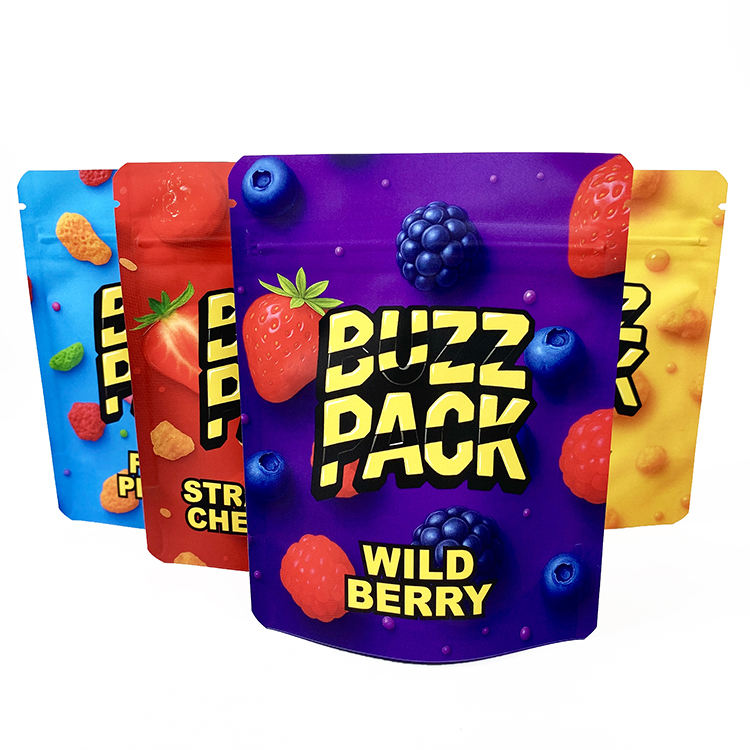
Custom printed foil laminated PE ziplock bags are resealable flexible bags made with a foil-laminated PE structure for cannabis brands, distributors, wholesalers, and private-label buyers managing one or more SKUs. The combination of custom printing, a resealable ziplock, and a foil-containing laminate gives procurement teams a practical starting point for discussing aroma containment, light exposure, moisture management, product protection, and branded presentation. Final performance depends on the complete laminate, seal design, closure specification, filling process, and destination-market requirements.
Product Specifications
| Product type | Custom printed resealable foil-laminated PE ziplock bag |
|---|---|
| Material structure | Foil-laminated PE; the exact layer construction and gauges require confirmation |
| Closure | Resealable ziplock closure; this is not automatically a tested child-resistant closure |
| Printing | Custom printing; artwork method, print coverage, colors, and registration require confirmation |
| Format and dimensions | Bag dimensions, opening, seal area, gusset configuration, and usable fill volume require confirmation |
| Intended B2B use | Cannabis product packaging programs, including private-label, wholesale, and multi-SKU applications, subject to product and market requirements |
| Performance data | Barrier, seal, odor, moisture, oxygen, and puncture results require confirmation for the selected specification |
How the Foil-Laminated PE Structure Affects Product Protection
The foil-containing layer can help reduce light transmission, while the PE component can contribute to flexibility, sealability, and contact-layer selection depending on the final construction. This does not establish a universal barrier rating. Oxygen transmission rate, moisture vapor transmission rate, aroma containment, puncture resistance, and heat-seal strength depend on the complete laminate, thickness, seal geometry, zipper design, and production settings.
For aromatic cannabis products, the resealable closure may help contain aroma between openings when the bag is correctly filled, closed, and heat sealed where applicable. It should not be described as completely smell proof without test data. If flower is being packed, ask the supplier to review density, expected volume, headspace, and the relationship between zipper placement and the primary heat seal. A bag that is too large may leave unnecessary headspace; one that is too small can compress the contents or interfere with sealing.
Choosing Size, Volume, and Filling Parameters
A stated fill weight does not identify one universal bag size. Cannabis flower density varies by product, trim, moisture condition, and packing method, so the same nominal weight can require different usable volumes. For edibles, product geometry, grease or oil exposure, moisture sensitivity, and serving information may drive a different specification. Confirm the actual product dimensions, target fill weight, desired headspace, and whether the bag will be filled manually, with a semi-automatic system, or on an automated line.
Before approving production artwork, request samples or a dimensional review for the chosen bag size. Check the opening width, bottom and side seal positions, zipper clearance, product insertion path, and the amount of material available for legally required information. If the format includes a gusset, confirm how it opens during filling and whether the finished package stands or remains flat. If no gusset is selected, usable volume and seal geometry should be evaluated with the actual contents.
Resealable Ziplock Versus Child-Resistant Closure
This product has a resealable ziplock closure. A standard zipper supports repeated opening and closing, but it is not automatically equivalent to a tested child-resistant package. If the destination market requires child-resistant packaging, specify that requirement at the RFQ stage and request the appropriate closure or package configuration. Do not rely on the word “ziplock” alone as evidence of testing, approval, or compliance.
A heat seal can provide an additional tamper-evident or freshness-oriented barrier when included in the final design, but the bag input confirms resealability rather than a separate heat-seal feature. Confirm whether the program needs a top heat seal, tear notch, or another opening aid. These features affect filling speed, consumer opening behavior, artwork space, and the way the finished package is inspected.
Custom Printing, Artwork, and Multi-SKU Control
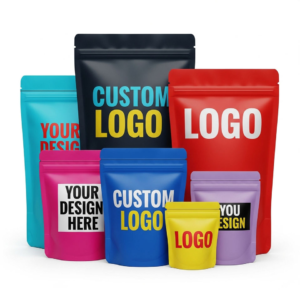
Custom printing allows a cannabis brand or private-label buyer to coordinate strain, flavor, potency, size, and market information across a packaging family. The printable area is limited by the zipper, seals, tear features, gusset folds, and die line. Ask for the approved template before final artwork, including safe zones, bleed, barcode placement, warning-panel space, and any restrictions caused by the foil-laminated PE structure.
For multi-SKU programs, establish a version-control process before ordering. Confirm which elements remain consistent across all bags and which change by SKU, such as strain name, product type, net quantity, batch field, or color coding. A shared bag architecture can simplify line setup and brand recognition, but different contents may still require different dimensions, barrier priorities, or filling instructions. Printed appearance can also vary with substrate, ink system, surface finish, and metallic or foil effects, so approve a representative proof or sample where color matching matters.
Trade-Offs for Procurement Teams
The foil-laminated construction can support a stronger light and barrier conversation than a simple unlaminated PE bag, but additional layers may affect stiffness, fold behavior, recyclability considerations, cost, and print appearance. A more protective structure is not automatically the best choice for every product. For light-sensitive or highly aromatic contents, barrier priorities may outweigh a preference for transparency. For products where visual inspection matters, a clear window could improve visibility but may reduce light protection in that area. Any window, matte effect, metallic appearance, or special finish must be confirmed as part of the complete structure rather than assumed from the product name.
Destination-Market and Compliance Review
Packaging requirements differ by destination, product category, closure type, labeling rules, and retail or distribution channel. Before production, confirm the applicable cannabis, food-contact, warning, child-resistance, recycling, and labeling requirements with the responsible compliance team or local adviser. Request only the technical documents and test evidence relevant to the selected structure and market. The bag description alone does not establish certification, approval, food-contact status, child resistance, or full regulatory compliance.
Frequently Asked Questions
Are these bags suitable for cannabis flower?
They can be evaluated for cannabis flower packaging because they combine a resealable ziplock with a foil-laminated PE structure. Suitability depends on flower density, fill weight, headspace, aroma expectations, dimensions, seal design, and destination-market requirements.
Are foil laminated PE ziplock bags smell proof?
They should not be treated as permanently or completely smell proof without product-specific test data. The selected laminate, zipper, heat seal, closure condition, and filling process influence aroma containment. When properly specified and closed, the structure may help contain aroma.
Can the bags be custom printed for several cannabis SKUs?
Yes, the product is identified as custom printed. Multi-SKU buyers should confirm artwork versions, printable area, color requirements, variable information, proofing, and how each version will be controlled before production.
Is the resealable zipper child resistant?
Not automatically. A resealable ziplock supports repeated opening and closing, but child resistance requires a separate tested package or closure specification where the destination market requires it.
What information is needed for an accurate quotation?
Provide the contents, fill weight or actual product dimensions, desired bag dimensions, quantity, artwork versions, material or barrier target, closure requirements, finish, filling method, destination market, and compliance needs. These inputs allow the supplier to assess size, structure, printing, and testing requirements.
Request a B2B Specification Review
For a quotation on this custom printed cannabis packaging, send the contents, fill weight or actual product dimensions, desired pouch dimensions, estimated quantity, number of artwork versions, required material or barrier, closure and heat-seal preferences, finish, filling method, destination market, and compliance needs. A cannabis packaging manufacturer or wholesale supplier can then confirm the practical structure, artwork area, sampling requirements, and specification details for your program without assuming performance data that has not been tested.

Reviews
There are no reviews yet.