
Custom Printed Flat-Bottom Pet Food Bags with Zipper
Custom printed flat-bottom pet food bags are flexible pouches made for packing pet food while presenting branded artwork across a stable, box-like format. The flat base supports upright display, while the zipper allows the package to be reclosed after opening. These bags are relevant to pet food brands, contract packers, distributors, wholesalers, private-label buyers and businesses managing multiple recipes, flavors or package sizes.
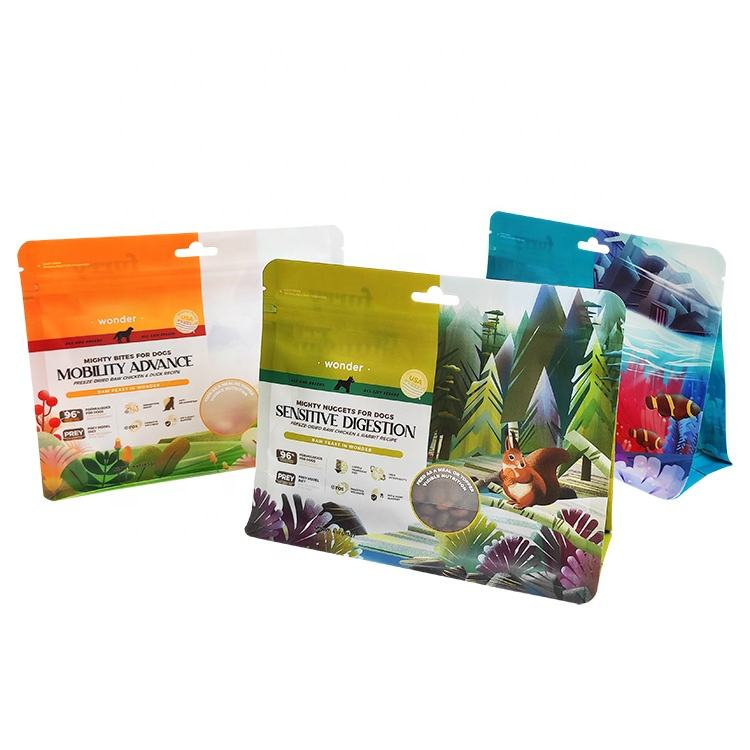
Product Specifications
| Product type | Custom printed flexible packaging bag |
|---|---|
| Pouch style | Flat-bottom bag |
| Intended contents | Pet food; the exact food format must be confirmed |
| Closure | Resealable zipper; final zipper type and seal arrangement require confirmation |
| Printing | Custom printed; artwork count, colors, print method and coverage are subject to the approved specification |
| Material or laminate | Not stated; select according to the product, barrier target, filling process and destination-market requirements |
| Dimensions and capacity | To be confirmed from fill weight, product density, particle dimensions, headspace and filling needs |
| Finish | To be specified during quotation |
| Buyer type | Brands, private-label programs, contract packers, distributors, wholesalers and multi-SKU purchasers |
How the Flat-Bottom Format Works
A flat-bottom pouch uses a defined base and side panels to create a more structured pack than a simple flat bag. This geometry can improve shelf presentation and provides multiple printable faces for branding, feeding information, ingredients, warnings, barcodes and other required content. Actual panel dimensions depend on the final bag width, height, side-gusset depth, bottom construction and seal geometry.
The bag should be evaluated with the real pet food rather than fill weight alone. Dense kibble, lightweight treats, irregular biscuits, freeze-dried pieces and powdered supplements occupy different volumes at the same weight. Large or sharp pieces may also need more clearance and greater puncture resistance. A production-size fill test can help establish usable volume, settling behavior, headspace and zipper clearance before the final dimensions are approved.
Laminate Selection and Product Protection
The material structure is not established by the product name or printed appearance. Flat-bottom laminated pet food pouches can be configured with different layers depending on the required stiffness, print surface, sealability and protection level. The complete laminate, zipper and heat-seal system determines package performance.
- Moisture control: A suitable moisture barrier can help limit texture changes caused by humidity entering or leaving the package.
- Oxygen and aroma control: The selected barrier may help protect oxygen-sensitive fats and contain product aroma when the pouch is properly sealed.
- Grease resistance: Foods with oils or fatty coatings require a structure evaluated for contact with that formulation.
- Puncture resistance: Hard kibble edges and irregular treats can place concentrated stress on the pouch during filling and transport.
- Light protection: Opaque or metallic-looking constructions may reduce light exposure, but appearance alone does not prove a specific barrier level.
- Heat sealability: The inner sealant layer must suit the filling process, sealing equipment and product contamination risk at the seal area.
Higher-barrier or thicker structures may improve stiffness and protection, but they can also increase material use and change sealing conditions, pack flexibility and cost. The best specification is therefore based on the pet food’s sensitivity and distribution conditions rather than selecting the most complex laminate by default.
Zipper Reclosure and Final Heat Seal
These resealable zipper bags for pet food support repeated opening and closing after the consumer first accesses the contents. The zipper helps with household storage, but it should not automatically be treated as the original tamper-evident seal or as a permanent airtight barrier. A filled bag may require a final heat seal above the zipper, depending on the packaging design and filling process.
Zipper position affects the opening size, top headspace and available artwork area. Fine powders, crumbs or greasy particles can interfere with zipper engagement or contaminate the heat-seal zone, so buyers should disclose the food format and filling method. Tear notches, easy-open geometry or other opening features may be considered conditionally during structural design.
Custom Printing and Multi-SKU Artwork
Custom pet food packaging pouches can allocate separate panels to brand graphics, flavor or recipe identification, feeding instructions and regulated information. Available print method, color handling, surface finish and special effects depend on the selected substrate, order specification and artwork requirements. Final production should use an approved dieline rather than artwork prepared from estimated panel dimensions.
For OEM multi-SKU pet food bags, establish a shared layout system before adapting files across recipes or weights. Consistent logo position, color management, barcode placement and information hierarchy reduce avoidable variation between SKUs. Each version should still receive its own artwork review because text volume, legal statements and barcode data may differ.
A matte, gloss, metallic or kraft-style appearance does not define the underlying barrier. If a transparent window is requested, it can provide product visibility but may reduce light protection in that area. Window position must also account for gusset folds, seals, zipper clearance and artwork registration.
Filling, Packing and Distribution Checks
Before confirming the bag, test the intended contents with the planned filling line. Manual, semi-automatic and automatic filling systems can require different top openings, pouch stiffness and zipper clearance. Buyers should also confirm whether the bag must remain open during filling, how air is displaced and whether the product needs settling before the final seal.
The flat-bottom design provides shelf stability, but performance still depends on dimensional balance and fill distribution. A base that is too narrow for the filled shape may be less stable, while excessive headspace can make the pack look underfilled. Insufficient headspace can place product in the zipper or heat-seal area. Secondary cartons and transport orientation should be considered when evaluating abrasion and compression risks.
Food-Contact and Destination-Market Requirements
Food-contact suitability and labeling compliance cannot be inferred from the pouch style or image. Buyers should identify the destination market, pet food category, expected shelf-life study, storage environment and documentation required by their compliance team. Material declarations, migration requirements, inks, adhesives and other supporting documents must be agreed against the final structure and intended use rather than assumed from a generic bag description.
When comparing a wholesale pet food packaging supplier, request a written specification that identifies dimensions, tolerances, laminate construction, zipper, print details and sealing conditions. This creates a more useful comparison than evaluating visual samples alone.
Frequently Asked Questions
What pouch size is needed for a stated pet food weight?
Fill weight does not establish one universal pouch size. The correct dimensions depend on product density, particle size, settling, required headspace, gusset geometry and the filling process.
Does the zipper make the bag airtight?
The zipper provides reclosure but should not be assumed to create a permanent airtight seal. Aroma and barrier performance depend on the complete laminate, zipper engagement and final heat seal.
Are these bags confirmed as food-contact compliant?
Compliance cannot be confirmed from the product name or image. The destination market, intended pet food, final material structure, inks, adhesives and required documentation must be reviewed before production.
Can several pet food SKUs use the same packaging format?
Multiple artwork versions may be quoted around a shared pouch format, subject to consistent dimensions and technical requirements. Each SKU still needs its own approved artwork and product information review.
What barrier structure should be specified?
The structure should be selected from the food’s sensitivity to moisture, oxygen, aroma, grease, light and puncture, together with shelf-life targets, distribution conditions and sealing equipment.
Request a Product-Specific B2B Quotation
For an accurate RFQ, provide the pet food type, fill weight, bulk density or representative sample, particle dimensions, desired pouch dimensions, order quantity, number of artwork versions, preferred finish, barrier priorities, zipper and opening requirements, filling method, destination market and required food-contact or labeling documentation. These inputs allow the flat-bottom geometry, laminate, print plan and sealing specification to be evaluated for the actual product rather than estimated from weight alone.
Reviews
There are no reviews yet.