
Custom Printed Child-Resistant Mylar Bags for Herb Storage
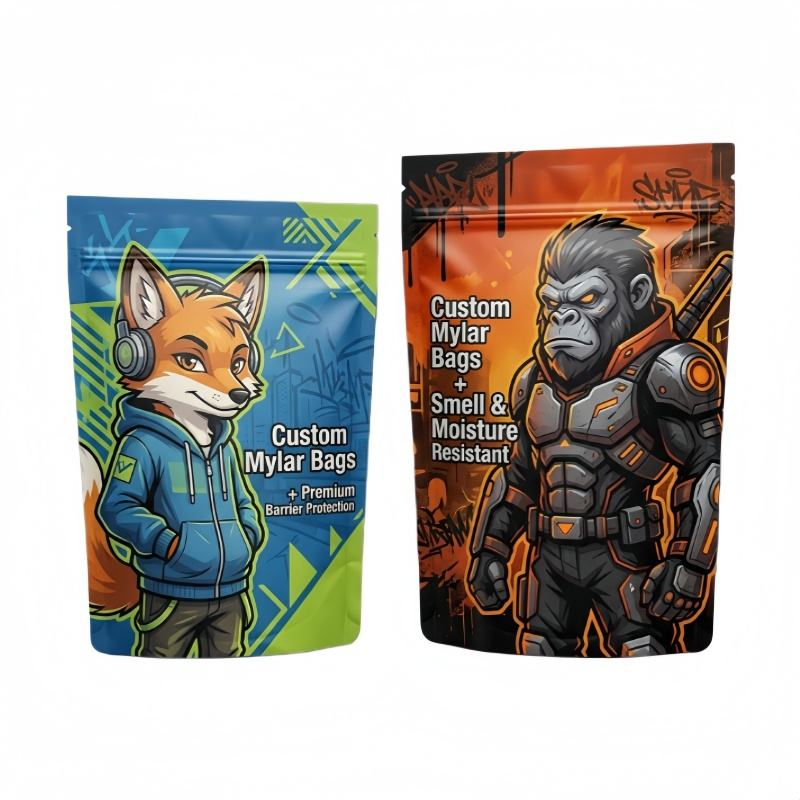
Custom printed child-resistant Mylar bags are flexible packaging bags for brands, distributors, wholesalers, private-label programs, and multi-SKU buyers storing dried herb products. The defining attributes are the Mylar-based bag format, custom printing capability, and a child-resistant opening configuration identified for herb storage. Final dimensions, laminate structure, closure design, artwork, and destination-market requirements should be confirmed before an RFQ or production approval.
Product Specifications
| Product type | Flexible Mylar bag for herb storage |
|---|---|
| Primary use | Storage and presentation of dried herb products; confirm the exact product and fill requirements |
| Child-resistant feature | Child-resistant bag configuration; ask for the selected closure details and any applicable test documentation |
| Printing | Custom printing is available as part of the product specification; confirm artwork process, print area, colors, and limitations |
| Material structure | Mylar-based structure; the complete laminate and barrier layers require confirmation for the intended product |
| Dimensions and capacity | Not stated; select dimensions according to product density, fill weight, headspace, and sealing requirements |
| Finish and opening | Confirm finish, zipper or other closure arrangement, tear feature, and heat-seal requirements before ordering |
How the Bag Should Be Specified for Herb
Dried herb is not defined by fill weight alone. Two products with the same target weight can require different bag dimensions because density, particle size, flower structure, compression, and acceptable headspace vary. A bag that is too small can compress the contents, interfere with the seal, or make filling inconsistent. A bag that is too large can create excess headspace, increase material use, and make the pack look underfilled.
For an accurate specification, provide the actual product dimensions or a representative sample, target fill weight, expected density range, preferred pouch dimensions, and the amount of headspace needed above the product. If the bag will be filled by hand, semi-automatically, or on an automated line, the filling method also matters. The opening width, bag stiffness, gusset arrangement, and seal geometry should work with the equipment and operator handling process.
Mylar Structure, Aroma, and Barrier Trade-Offs
Mylar is commonly used as a reference for a strong flexible film, but the appearance of a bag does not by itself identify its complete barrier performance. Odor retention, aroma protection, moisture control, oxygen resistance, light protection, puncture resistance, stiffness, and heat sealability depend on the full laminate structure and the quality of the finished seals. A metallic or opaque appearance may support light protection, while a clear window can improve product visibility but may allow more light exposure in that area.
For herb packaging, the buyer should request the proposed material construction and clarify which performance priorities matter most. A structure selected to improve stiffness or puncture resistance may affect foldability and opening behavior. A structure optimized for barrier protection may influence printing, sealing temperature, or cost. Smell-resistant performance should be treated as a specification to verify rather than an absolute guarantee. The bag can help contain aroma when the selected structure is suitable and the package is properly sealed.
Child-Resistant Opening Versus Ordinary Resealability
A standard zipper can provide convenient resealing, but it should not automatically be described as child-resistant. This product is identified as having a child-resistant configuration, so the exact opening mechanism, operating instructions, and available test documentation should be confirmed for the version being quoted. Buyers should also determine whether the design combines a child-resistant feature with a heat seal, tear notch, or resealable closure.
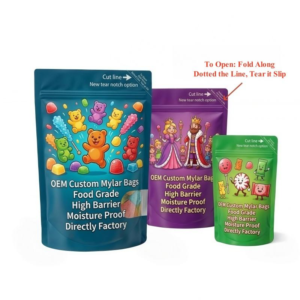
A heat seal can provide evidence of initial opening and help protect the package after filling, but it changes the filling workflow and is not the same as a child-resistant mechanism. A tear notch can make opening easier for an authorized user, yet its location must not compromise the seal or the intended child-resistant function. Confirm how the bag will be opened, resealed, inspected, and disposed of in the destination market.
Custom Printing for Cannabis and Herb Product Lines
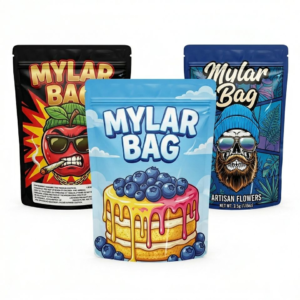
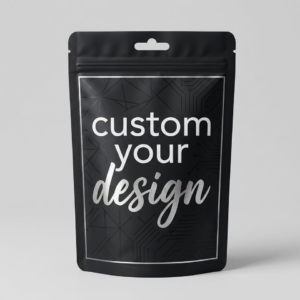
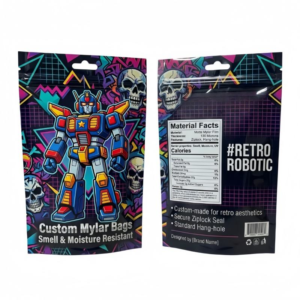
Custom printing allows a brand to separate strains, product variants, private-label programs, or wholesale customer versions using consistent visual packaging. Before artwork is prepared, request the bag die line or printable-area guidance. Confirm the usable front and back panels, seal exclusion zones, zipper or closure position, tear-notch location, gusset visibility, barcode placement, and any required warning or regulatory space.
Finish selection should be evaluated with the substrate and laminate rather than treated as a purely visual decision. Matte, gloss, metallic, holographic, kraft-look, and other appearances may be configurable depending on the selected construction, but they do not independently prove a particular moisture, oxygen, odor, or light barrier. Also confirm color expectations, small text legibility, variable-data requirements, artwork versions, and whether every SKU will use the same dimensions and material.
Multi-SKU and Private-Label Procurement
For a multi-SKU or private-label order, define what must remain consistent across the range. Useful controls include the approved bag dimensions, material structure, closure behavior, print position, color references, barcode area, warning-panel layout, and version naming. If strains or herb varieties differ in density, a single nominal bag size may not provide the same fill appearance or headspace for every SKU.
Send a representative product sample or accurate product measurements for each materially different item. Identify which SKUs share a specification and which require a separate size or artwork file. This approach helps the supplier quote the actual packaging program instead of assuming that one fill weight or one design fits the complete range.
Destination-Market Review Before Production
Regulatory and packaging requirements depend on the destination market, product category, closure design, labeling content, and sales channel. Before approval, confirm required warnings, child-resistant expectations, material or food-contact considerations where applicable, barcode and traceability needs, recyclability statements, and any local rules governing cannabis or herb packaging. Do not rely on the bag name alone as proof of compliance. Request the relevant technical documentation for the selected structure and closure, and have the buyer’s compliance team review the final printed artwork.
Questions Buyers Should Resolve Before an RFQ
- What herb product will be packed, and what are its target fill weight, dimensions, density, and headspace requirements?
- Is the required opening a tested child-resistant design, a resealable zipper, a heat-sealed format, or a combination?
- Which barrier priorities matter most: aroma containment, moisture control, oxygen resistance, light protection, or puncture resistance?
- What bag dimensions, finish, printable area, artwork versions, and SKU consistency requirements are needed?
- Which destination market, filling method, labeling rules, and compliance documents must be addressed?
Frequently Asked Questions
Are these bags suitable for dried herb storage?
They are identified for herb storage, but suitability depends on the product’s fill weight, density, dimensions, headspace, and required barrier performance. Confirm the proposed structure and test the filled package before approving production.
Does Mylar alone guarantee odor or moisture protection?
No. Odor, moisture, oxygen, and light performance depend on the complete laminate, seal quality, closure, and handling conditions. A suitable bag can help contain aroma and protect the contents when properly specified and sealed.
Is a child-resistant bag the same as a regular resealable zipper bag?
No. A regular zipper provides resealing convenience but should not automatically be treated as child-resistant. Confirm the exact closure design and request applicable test documentation for the quoted version.
Can one bag size serve every herb SKU?
Not necessarily. Product density, structure, fill weight, and desired headspace can change the required dimensions. Compare representative samples and measurements for each materially different SKU.
What should a buyer provide for a quotation?
Provide the contents, fill weight or actual product dimensions, desired bag dimensions, quantity, artwork versions, material or barrier priorities, closure, finish, filling method, destination market, and compliance needs.
Request a Product-Specific B2B Quote
To request an accurate quotation for these custom printed child-resistant Mylar bags, send the packed herb details, target fill weight or actual product measurements, desired pouch dimensions, quantity, number of artwork versions, preferred material or barrier priorities, closure and finish requirements, filling method, destination market, and compliance documentation needs. These inputs allow the packaging specification to be reviewed around the actual product rather than an assumed size or generic bag format.
Reviews
There are no reviews yet.