
Custom Printed Child-Proof Smell-Proof Zip Bags for Cannabis Packaging
Custom printed child-proof smell-proof zip bags are flexible cannabis packaging bags specified for 3.5g–14g product fills, with custom branding, a resealable zip-style opening, and an odor-resistant packaging objective when the selected structure is properly sealed. They are relevant to cannabis brands, private-label operators, distributors, wholesalers, and multi-SKU buyers who need one packaging format adapted across several strains, products, or artwork versions.
The stated fill range does not establish one universal bag dimension. Flower density, bud size, trim, desired headspace, filling method, and the position of the seal all affect the usable volume. Before approving production, the buyer should confirm the actual product dimensions and request a size recommendation or physical sample based on the intended fill.
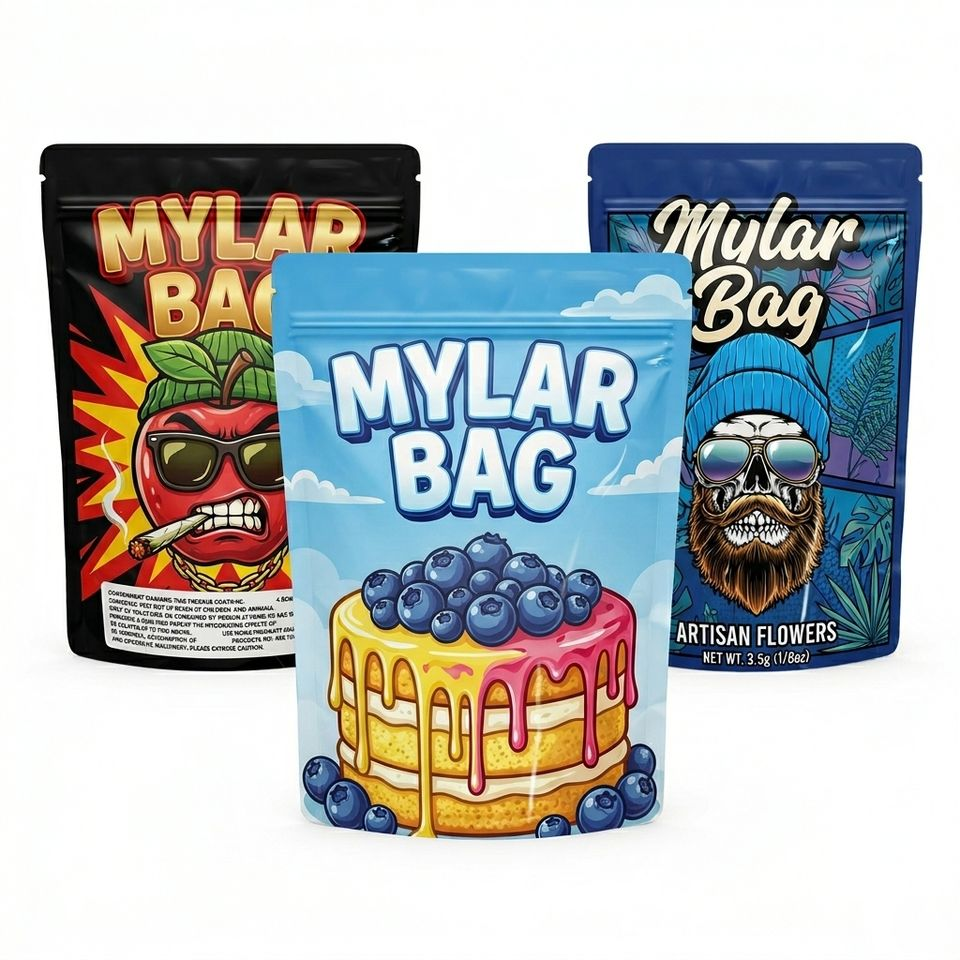
Product Specifications
| Product type | Custom printed zip bags for cannabis packaging |
|---|---|
| Stated fill range | 3.5g–14g; final usable volume depends on product density and bag dimensions |
| Closure | Child-proof closure is stated; confirm the exact mechanism and any destination-market testing requirements |
| Odor function | Smell-proof positioning; actual aroma containment depends on the complete structure, seal geometry, and proper sealing |
| Printing | Custom printing; confirm artwork area, print colors, substrate limits, and proofing process |
| Material | Flexible barrier structure to be confirmed for the selected application |
| Dimensions | Not provided; confirm bag width, height, seal area, opening position, and usable fill volume |
| Finish and style | Not specified; confirm preferred appearance, surface finish, and pouch construction before quotation |
Barrier Structure and Odor Control
Smell resistance is not created by the printed artwork or exterior appearance alone. It depends on the complete flexible packaging structure, including the selected film layers, sealant, zipper area, bottom and side seals if applicable, and the quality of the finished seal. A suitable barrier structure may help contain cannabis aroma and may also help manage exposure to moisture, oxygen, and light, depending on the final laminate specification. These functions should be confirmed against the product’s storage needs rather than assumed from the phrase “smell-proof.”
Material selection involves a practical trade-off. A higher-barrier structure can provide stronger protection against environmental exposure, but it may affect stiffness, fold behavior, appearance, cost, or printing constraints. A clear window can improve product visibility, while an opaque or metallized structure may provide better light protection. Matte, metallic, holographic, or kraft-style appearance does not by itself identify the barrier performance. Ask for the complete structure and sealing recommendation when aroma retention or shelf stability is important.
Fill Weight, Density, and Headspace Planning
The 3.5g–14g range is a useful starting point for cannabis flower programs, but weight alone cannot determine bag size. Dense flower may occupy less space than light, bulky flower at the same stated weight. Large buds can also require more headspace and a wider opening to reduce compression during filling. Too little headspace can make zipper engagement and final heat sealing difficult; too much headspace can increase movement and reduce presentation efficiency.
For an accurate specification, provide the actual product dimensions, typical density, target fill weight, acceptable headspace, and whether the bag will be filled manually or through a production line. If multiple strains or SKUs vary substantially in density, test the smallest and largest practical fill conditions. This helps a buyer decide whether one common bag size is appropriate or whether several sizes are needed.
Zip Closure, Heat Seal, and Child-Resistance Confirmation
The product is described as child-proof, but buyers should confirm what child-resistant feature is included. An ordinary resealable zipper is not automatically the same as a tested child-resistant closure. Request the closure description, opening method, sealing sequence, and any documentation or testing required for the destination market. The packaging should be evaluated with the final product and use instructions, not only as an empty bag.
A resealable zip can support repeated access, while a heat seal can provide an additional tamper-evident or aroma-containment step when the construction and sealing process are suitable. These functions are different: the zipper supports reclosure, and the heat seal creates a sealed top area that must be opened before use. Confirm whether the requested design includes a tear notch, a heat-seal zone above the zipper, or another opening feature. Seal width, temperature, dwell time, pressure, and filling-line compatibility should be finalized during technical approval.
Custom Printing for Multi-SKU Cannabis Programs
Custom printing allows a brand to coordinate strain names, product variants, logos, regulatory panels, batch fields, and other artwork across a packaging range. For multi-SKU purchasing, establish a master design system before submitting files. Define which elements remain consistent and which change by SKU, such as strain color, product name, potency panel, flavor, or barcode area.
Artwork should be prepared around the confirmed die line, usable print area, seals, zipper position, opening direction, and any area that may be covered during filling. Ask whether the selected substrate supports the required color appearance and whether the requested finish changes contrast or legibility. A printed sample or proof is useful for checking small text, registration, brand colors, and the relationship between front-panel graphics and the final bag shape.
Specification Trade-Off: One Size or Multiple Sizes
Using one bag size across 3.5g, 7g, and 14g variants can simplify artwork management, purchasing, and inventory. However, a single format may create excess headspace for smaller fills or compression and difficult sealing for larger, bulky fills. Multiple sizes can improve fit and presentation but introduce additional artwork versions, stock-keeping requirements, and approval steps. The right decision depends on product density, filling equipment, expected sales mix, and the buyer’s tolerance for packaging variation.
Destination-Market and Procurement Checks
Packaging requirements vary by destination and by the type of cannabis product being packed. Confirm the applicable rules for child-resistant packaging, warning and required information space, tamper evidence, labeling, materials, and any food-contact or product-contact expectations. Do not assume that a “child-proof” description alone satisfies a local requirement. The buyer should also confirm whether the final bag must support heat sealing, lot coding, barcode application, inspection, or a specific filling workflow.
For wholesale, OEM, ODM, and private-label programs, align the specification before requesting commercial terms. Useful RFQ information includes the contents, actual fill weight, product dimensions, desired bag dimensions, quantity, number of artwork versions, material or barrier preference, closure requirement, finish, filling method, destination market, and compliance documentation needs. A cannabis packaging bag manufacturer or supplier can then evaluate the complete application rather than quoting from weight alone.
Frequently Asked Questions
Are these bags suitable for 3.5g to 14g cannabis fills?
They are specified for the stated 3.5g–14g range, but the correct bag size must be confirmed using product density, bud dimensions, desired headspace, and the filling method. One size may not fit every fill condition equally well.
Does “smell-proof” guarantee complete odor elimination?
No. The phrase describes the intended odor-resistant function. Aroma containment depends on the complete laminate, zipper and seal design, heat-seal quality, and proper closure. Confirm the structure and sealing process for the intended cannabis product.
Is the zipper automatically a tested child-resistant closure?
No. A standard resealable zipper and a tested child-resistant closure are not automatically equivalent. Confirm the exact closure mechanism and the testing or documentation required for the destination market.
Can one printed bag design cover several strains or SKUs?
Yes, the artwork program can be planned around shared brand elements and SKU-specific information, subject to the confirmed print area, die line, substrate, and number of artwork versions. Review proofs for each variant before approval.
What should be supplied for an RFQ?
Provide the contents, fill weight, actual product dimensions, desired bag dimensions, quantity, artwork versions, preferred material or barrier, closure, finish, filling method, destination market, and compliance needs. These details support a more useful specification and quotation review.
Request a B2B Packaging Specification
To discuss these custom printed child-proof smell-proof zip bags, send the intended contents, fill weight, actual product dimensions, desired pouch dimensions, quantity, artwork version count, material or barrier preference, closure, finish, filling method, destination market, and compliance requirements. The specification can then be reviewed for fit, sealing, aroma-control objectives, printing, and multi-SKU consistency before an RFQ is finalized.

Reviews
There are no reviews yet.