
Custom Printed Child-Resistant Die-Cut Mylar Bags for Cannabis Packaging
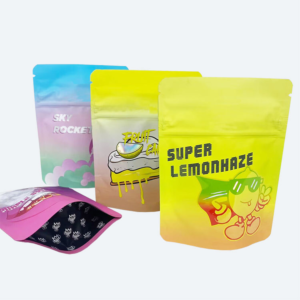
Custom printed child-resistant die-cut Mylar bags are shaped flexible bags specified for 1g–28g product fills, custom branding, and a child-resistant packaging format. They are a practical B2B option for cannabis brands, distributors, wholesalers, private-label programs, and multi-SKU buyers that need several branded package versions rather than a generic stock pouch. The stated fill range does not establish one universal bag size, so the final die line should be confirmed against the actual product, density, headspace, filling method, closure, and destination-market requirements.

Product Specifications
| Product type | Custom printed die-cut Mylar bag |
|---|---|
| Stated fill range | 1g–28g; final usable volume must be confirmed with the product density and format |
| Child-resistant feature | Child-resistant packaging format stated; closure construction, testing, and destination-market requirements must be confirmed |
| Printing | Custom printed; artwork process, print coverage, colors, and registration limits require specification |
| Material | Mylar bag; complete laminate structure, barrier layers, and seal performance require confirmation |
| Shape | Die-cut; final outline, seal geometry, opening position, and usable artwork area require approval |
| Finish | Not specified; matte, gloss, metallic, holographic, or other appearance options are subject to the selected structure |
| Intended application | Cannabis packaging or another regulated product application, subject to contents and market requirements |
Fill Weight, Density, and Headspace
A 1g fill and a 28g fill behave differently inside flexible packaging. Flower density, particle size, moisture condition, and whether the contents are loose or otherwise portioned affect the required internal volume. Headspace also affects how easily the bag fills, seals, stores, and presents on shelf. For that reason, buyers should not select a die-cut outline from weight alone. Provide a physical sample, actual product dimensions, or a target internal volume when requesting a quotation.
For cannabis flower, the specification should account for aroma containment, gentle handling, and enough room for the product to settle without forcing material into the seal area. A tight fill may improve visual compactness but can increase filling difficulty and place pressure near the seal. Excessive headspace can affect presentation and may allow more product movement. These are design decisions to confirm through sampling rather than assumptions based only on the nominal gram range.
Mylar Structure and Barrier Considerations
“Mylar” identifies the bag format or film terminology, but the appearance alone does not establish the complete barrier structure. The laminate and sealing system determine how the finished bag performs against aroma, moisture, oxygen, light, puncture, stiffness, and heat. A suitable structure can help contain aroma and protect product quality when properly sealed, while the exact result depends on film selection, seal width, seal conditions, and the contents.
Ask the supplier to identify the proposed film layers, thickness or gauge, sealant, and intended barrier function. If aroma retention is important, request the relevant specification for the complete finished structure rather than relying on an absolute “smell proof” claim. A metallic or opaque appearance may support light protection, but a matte, holographic, kraft-look, or decorative finish does not by itself prove a specific moisture or oxygen barrier. A clear window can improve product visibility, yet it may reduce light protection in that area.
Die-Cut Shape, Seals, and Child-Resistant Opening
The die-cut profile affects usable volume, filling behavior, seal geometry, and the amount of flat surface available for artwork. Shaped corners or a narrow top can create a distinctive shelf presentation, but they may also reduce the practical filling opening or require more careful alignment during sealing. Confirm the pouch outline, opening position, seal width, tear-notch location, and any areas that must remain free of graphics.
A child-resistant format should not be confused with an ordinary resealable zipper. If a zipper, press-to-close feature, heat seal, tear notch, or other opening system is proposed, ask how it operates with the selected die-cut shape and film structure. A child-resistant claim should be matched to the required market, closure construction, and applicable testing or documentation. The visible product input states a child-resistant bag, but it does not establish a particular test, approval, certification, or compliance result.
Custom Printing and Multi-SKU Control
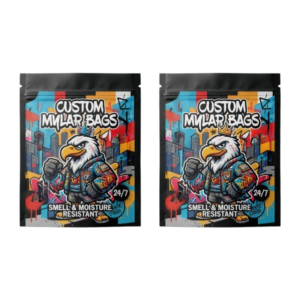
Custom printed weed packaging bags can support strain names, product variants, brand graphics, required panels, lot information, and market-specific artwork. Before artwork production, confirm the printable area inside the die line, the position of seals and opening features, color expectations, minimum type size, barcode placement, and whether the selected substrate supports the requested finish. Matte, gloss, metallic, or holographic effects can change color perception and may require a separate proofing decision.
For private-label cannabis bags for multiple SKUs, establish one master structural specification and document the variables that change between versions. These may include artwork, fill weight, product name, flavor or strain information, warning text, and barcode data. Keeping the die line, closure position, and core material consistent can simplify purchasing, but different fills may still require different dimensions or headspace. Confirm whether one format genuinely accommodates every SKU before consolidating the order.
Procurement Trade-Off: Appearance Versus Barrier and Filling
A highly shaped or highly decorative bag can create stronger visual differentiation, but more complex geometry may reduce the usable flat print area and make automated or manual filling less forgiving. Similarly, a transparent window improves visibility but trades away some opacity in that section. Buyers should prioritize the contents’ sensitivity, target fill, filling equipment, and destination-market information panel before choosing a decorative treatment. The best specification balances shelf appearance with reliable sealing, adequate internal volume, and legible required information.
Buyer Questions Before an RFQ
Can one bag size cover every fill from 1g to 28g?
Not automatically. Product density, format, headspace, and desired presentation determine whether one size is practical. Confirm each target fill with actual product information or samples.
Does the Mylar material guarantee odor containment?
No. Aroma containment depends on the complete laminate, sealant, closure, seal quality, and contents. Request structure and performance details for the finished bag, and use qualified expectations such as helping contain aroma when properly sealed.
Is a resealable zipper the same as child-resistant packaging?
No. A standard zipper provides resealability but does not by itself establish child resistance. Confirm the specific closure construction, operating method, and documentation required for the destination market.
Can the die-cut bags be printed for several cannabis strains?
Custom printing can be specified for multiple artwork versions, subject to the approved die line, print process, color requirements, and artwork area. Confirm how SKU changes affect the quotation and production specification.
What should a buyer provide for an accurate quotation?
Provide the contents, fill weight or actual product dimensions, desired pouch dimensions, quantity, number of artwork versions, material or barrier target, closure, finish, filling method, destination market, and compliance needs. Samples or dieline references can further reduce specification risk.
Request a Product-Specific B2B Quote
To evaluate these custom printed child-resistant die-cut Mylar bags, send the contents, target fill weight or actual product dimensions, desired pouch dimensions, quantity, artwork versions, material or barrier requirements, closure preference, finish, filling method, destination market, and compliance needs. The resulting RFQ can then be reviewed against the 1g–28g range, die-cut geometry, child-resistant opening, print area, headspace, and sealing requirements.

Reviews
There are no reviews yet.