
3.5g Child-Resistant Resealable Cali Mylar Bags for Cookies
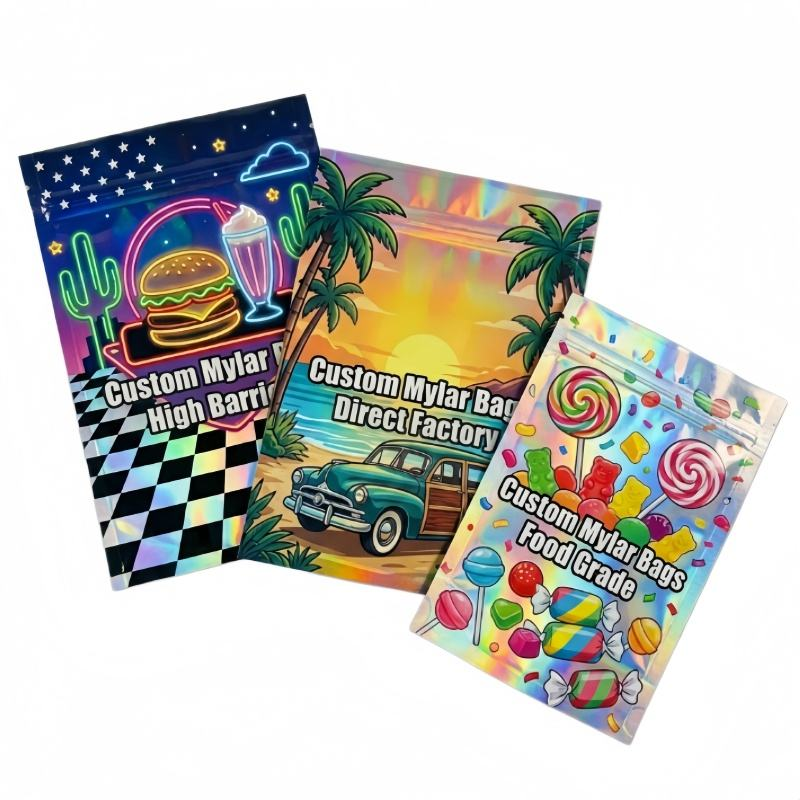
3.5g child-resistant resealable Cali Mylar bags are flexible bags intended for packaging a nominal 3.5g cookie product, including cannabis-infused cookies where permitted by the destination market. The stated child-resistant and resealable functions address access control and repeat opening, while the Mylar bag format provides a lightweight surface for product identification and brand artwork. These bags are suited to cannabis brands, private-label programs, distributors, wholesalers, importers and multi-SKU buyers who need one defined package concept before confirming dimensions, laminate construction, closure details and compliance requirements.
Product Specifications
| Product type | Child-resistant resealable Cali Mylar bag |
|---|---|
| Stated fill reference | 3.5g; actual required volume depends on cookie size, density, shape and headspace |
| Intended contents | Cookies, including cannabis cookies where allowed and properly labelled |
| Material | Mylar bag format; exact film and complete laminate structure require confirmation |
| Closure | Child-resistant resealable configuration; closure design, operating method and test documentation require confirmation |
| Printing | Custom printing can be discussed; artwork area, colors, registration and substrate limits require confirmation |
| Finish | Final finish is specification-dependent and should be selected with the laminate and artwork |
| Dimensions | Not provided; confirm flat size, usable internal area, seal geometry and opening position |
| Order details | Quantity, artwork versions, destination market and production requirements require confirmation |
How the 3.5g Reference Affects Bag Sizing
A 3.5g reference does not establish one universal bag dimension. Cookies vary in diameter, thickness, density, coating and breakage sensitivity, so weight alone cannot determine usable volume. Measure the finished cookie, including its greatest width, height and any irregular projections. Then allow practical headspace for filling, closure operation and label or printed information. Excess headspace can increase movement and crushing during handling; too little headspace can interfere with closing, reduce presentation quality and place stress on the seals.
For a procurement sample, provide the actual cookie dimensions and whether the product is individually wrapped, loose-filled or placed in an inner tray. That information helps determine the opening width, bottom construction, seal area and internal clearance. A production bag should be evaluated with the real cookie rather than an equivalent weight of a different product.
Barrier Structure, Aroma and Cookie Protection
The word Mylar does not by itself identify the complete barrier structure. A flexible cookie bag may be configured with different film layers, sealant layers and appearance treatments depending on the required balance of aroma containment, moisture protection, oxygen resistance, light protection, puncture resistance, stiffness and heat sealability. Barrier performance depends on the complete laminate and on the quality of the finished seal, not on the appearance alone.
For cookies, moisture control can affect texture, while grease or oil migration can influence film selection and seal cleanliness. If the cookies contain strong botanical aromas, a suitable structure can help contain aroma when properly sealed; an industry term such as smell resistant should not be treated as a permanent or absolute performance guarantee. Ask for the proposed laminate, sealant compatibility and any available test method or data relevant to the destination and product conditions.
A metallic or opaque appearance may support light protection, but appearance does not prove a particular oxygen or moisture barrier. A clear window, if requested, can improve product visibility but may trade away some light protection in that viewing area. The final choice should follow the cookie formulation, expected shelf conditions, filling equipment and required presentation.
Child-Resistant and Resealable Closure Considerations
The stated product configuration is child-resistant and resealable, but an ordinary resealable closure should not be treated as equivalent to a tested child-resistant system. Before approving the bag, confirm how the child-resistant mechanism operates, whether the closure is suitable for the intended market, what documentation is available and whether the finished package must be evaluated with the selected cookie and laminate.
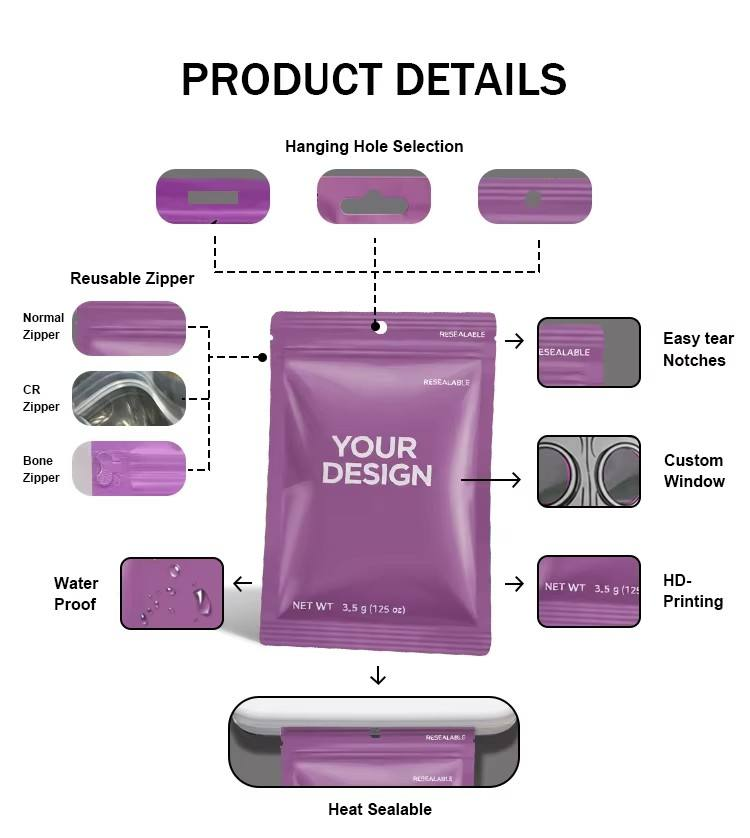
Resealing supports repeated access after opening, while a heat seal can provide a separate tamper-evident or initial-seal function if included in the final design. Do not assume that a heat seal, tear notch or resealable feature is included unless it appears in the approved specification. Confirm the tear-notch position, opening force, closure alignment and whether the filling line can close the package consistently without food or product contamination in the seal area.
Custom Printing for Cali Cookie SKUs
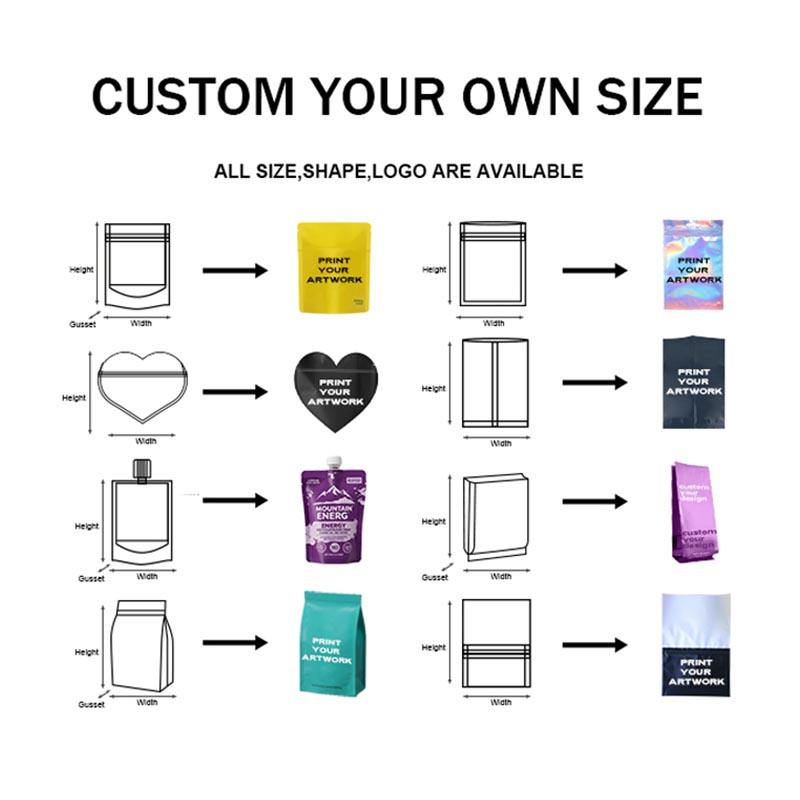
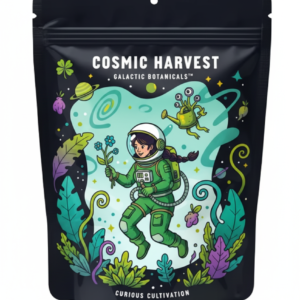
These bags can be considered for custom printed packaging programs, including a coordinated family of cookie or cannabis product SKUs. The printable area should be planned around the closure, tear notch, seals, gusset or folded areas and any required variable information. Ask for the dieline or approved artwork template before finalizing design. Substrate selection and surface treatment can affect color appearance, fine text, barcode readability, scuff resistance and registration.
For a multi-SKU range, keep the structural bag, closure behavior and key regulatory panels consistent where practical, while reserving controlled artwork zones for flavor, strain, potency or batch-specific information. Exact cannabis labeling requirements vary by destination. Confirm mandatory warnings, symbols, net contents, ingredients, allergen statements, child-resistance requirements, lot coding and language rules with the responsible compliance team before artwork approval. The packaging supplier can manufacture to the approved specification, but market compliance should not be assumed from the bag format alone.
Trade-Off: Barrier, Visibility and Filling Efficiency
A more opaque barrier-oriented structure may better support light and aroma management, but it can reduce direct product visibility and may require more deliberate artwork planning. A window or more transparent area can help inspection and merchandising, yet it may reduce protection in that area and make internal movement more visible. Similarly, a highly stiff structure may improve presentation and handling while requiring different folding or filling settings than a softer film. Select the balance with sample trials using the actual cookie, closure process and intended shipping conditions.
Multi-SKU and Wholesale Procurement Checks
For private-label, OEM or wholesale purchasing, define whether every SKU uses the same bag dimensions and laminate or whether different cookie shapes need separate formats. Confirm the number of artwork versions, variable data requirements, closure color, finish, print coverage, pack-out orientation and carton or case requirements during the RFQ process. A shared bag platform can simplify purchasing, but forcing different cookie geometries into one size may create excess headspace, crushed edges or inconsistent shelf presentation.
Importers and distributors should also confirm the destination market, food-contact expectations where applicable, cannabis packaging rules where applicable, documentation needs, labeling responsibility and any required child-resistant evaluation. Request samples for dimensional, closure and filling checks before approving a production specification. Pricing, MOQ, lead time, stock status and delivery terms are not defined here and must be quoted against the completed requirements.
Frequently Asked Questions
Are these bags sized for exactly 3.5g of cookies?
The product is identified with a 3.5g reference, but the correct dimensions depend on cookie density, shape, thickness, packaging method and desired headspace. Confirm actual product measurements before selecting a final bag size.
Does the Mylar format guarantee odor or moisture protection?
No. Mylar appearance or naming does not establish the complete laminate barrier. A suitable structure may help contain aroma and manage moisture when properly sealed, but the laminate and sealing system should be confirmed for the intended cookie.
Is the resealable closure automatically a tested child-resistant closure?
No. The product is described as child-resistant and resealable, but buyers should confirm the closure design, operating method and applicable test documentation. An ordinary resealable closure should not be treated as child-resistant without appropriate evidence.
Can these bags be custom printed for several cookie SKUs?
Custom printing can be discussed for a multi-SKU program. Confirm the artwork area, dieline, print coverage, number of versions, variable information, finish and substrate limitations before approval.
What should be included in an RFQ?
Provide the cookie dimensions, target fill weight, desired bag dimensions, quantity, artwork versions, laminate or barrier preference, closure requirements, finish, filling method, destination market and applicable compliance needs.
Request a B2B Specification and Quote
To request an accurate quotation for these bags, send the contents, nominal fill weight, actual cookie dimensions, desired pouch dimensions, quantity, number of artwork versions, material or barrier preference, child-resistant and resealable closure requirements, finish, filling method, destination market and compliance documentation needs. Ask for a pre-production sample or dimensional confirmation before approving the final specification.
Reviews
There are no reviews yet.