
Custom Printed 3.5g Edible Sachets for Cannabis Brands
Custom printed 3.5g edible sachets are food-grade flexible packages identified for a 3.5g edible fill and branded with product-specific graphics. They are relevant to cannabis brands, private-label operators, distributors, wholesalers, and multi-SKU buyers that need compact packaging for an edible product. The 3.5g weight does not establish the sachet dimensions, usable volume, laminate, barrier performance, closure, or regulatory suitability; those details must be matched to the actual edible and destination market before production.
Product Specifications
| Specification | Product detail |
|---|---|
| Product type | Custom printed food-grade edible sachet |
| Declared fill weight | 3.5g |
| Intended contents | Edibles; the exact format, density, oil content, and moisture sensitivity should be confirmed |
| Packaging structure | Flexible sachet; exact film or laminate structure requires buyer confirmation |
| Dimensions and usable volume | Not specified; determine from the actual product, headspace, seal area, and filling method |
| Printing | Custom printed; printing process, color targets, artwork area, and version count require confirmation |
| Closure | Not specified; seal format and any opening feature must be selected for the application |
| Child-resistant status | Not established by the product input; any required child-resistant system must be separately specified and documented |
| Finish | Not specified; available appearance depends on the selected substrate and printing configuration |
| Procurement model | Suitable for evaluation by brand, wholesale, private-label, OEM, ODM, and multi-SKU buyers |
Match the Sachet to the 3.5g Edible
A 3.5g gummy, chew, confection, infused powder, or other edible can have a different shape and displacement at the same weight. Buyers should provide the product’s actual length, width, thickness, and packed orientation rather than selecting dimensions from weight alone. The sachet must leave enough usable volume for filling and sealing without creating excessive empty space.
Small single-serve cannabis edible packaging can reduce material and display footprint, but a very tight pack may complicate insertion, contaminate the seal area, or compress a delicate edible. More headspace can improve filling tolerance, although it increases the package size and may allow additional product movement. A physical fill test is the most reliable way to resolve this trade-off.
Laminate, Food Contact, and Barrier Decisions
The term food-grade is a defining product attribute, but it does not identify the individual film layers or provide every document required by a buyer’s market. Flexible laminate edible pouches may be configured with sealant, print, and barrier layers selected for the food, packing process, and shelf-life objective. The exact construction should be documented in the approved specification.
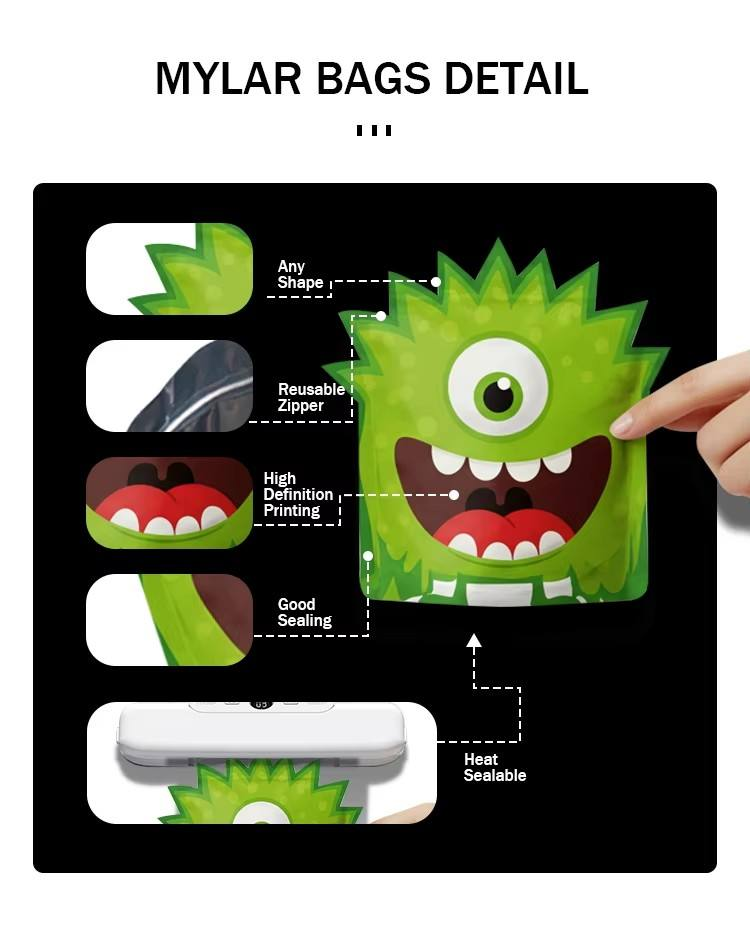
Barrier performance comes from the complete laminate and sealing system. Depending on the structure, the sachet can help limit moisture or oxygen transfer, contain aroma when properly sealed, resist puncture, and provide suitable stiffness for handling. A light-blocking layer may help protect light-sensitive contents, while a clear window improves visibility but reduces light protection in that area. No appearance—matte, gloss, metallic, holographic, kraft-style, or clear—proves a particular barrier level.
If the edible is oily or grease-prone, confirm compatibility with the food-contact layer, inks, adhesives, and seals. Buyers with defined shelf-life targets should request the applicable material structure and test requirements rather than relying on general terms such as smell resistant.
Sachet Geometry, Filling, and Opening
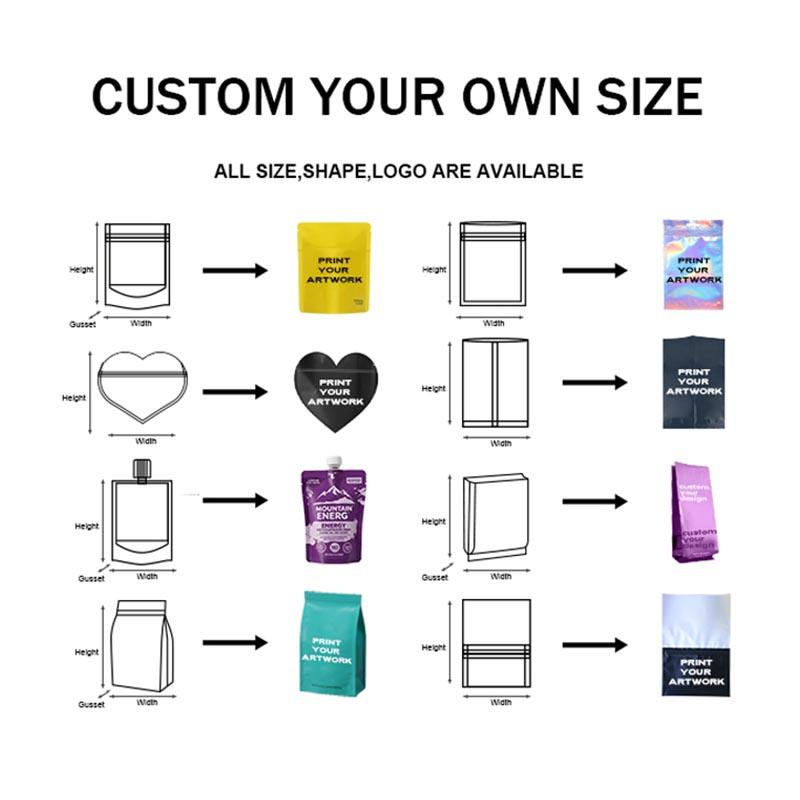
A sachet may use perimeter seals and a compact flat format, but the final die line, seal geometry, opening position, and any gusset must be confirmed. Manual filling and automated filling can require different web formats, registration marks, seal widths, and tolerances. The edible must remain clear of the heat-seal zone so that crumbs, sugar, powder, or oil do not interfere with seal formation.
Possible opening configurations may include a tear notch, straight cut, or another specified feature. A tear notch assists opening but is not a child-resistant mechanism. Likewise, an ordinary press-to-close zipper does not become child resistant merely because it is difficult to open. If resealability or child resistance is required, identify the closure system and the destination-market testing or documentation expected for the finished package.
Custom Printing and Multi-SKU Control
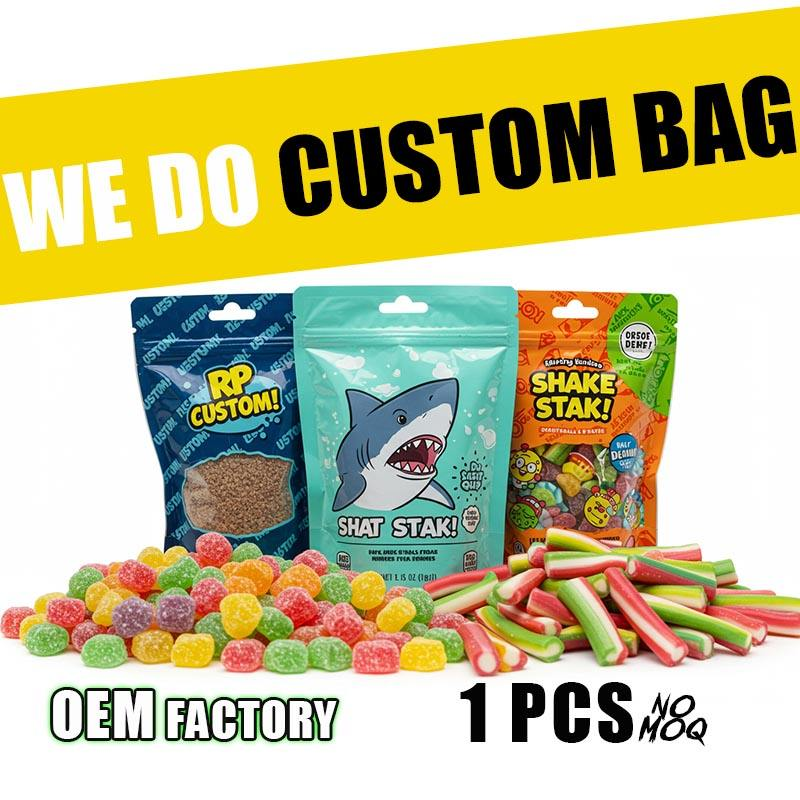
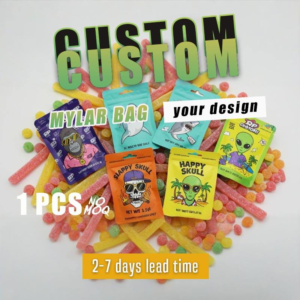
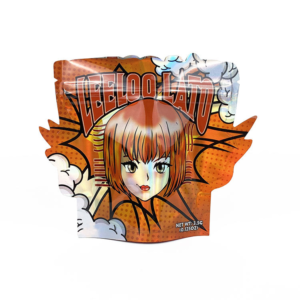
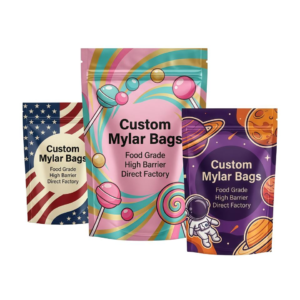
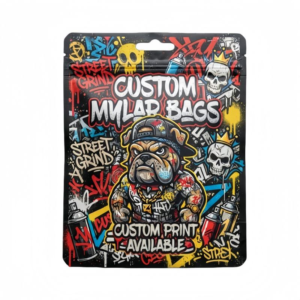
Custom printing can carry the brand identity, product name, flavor, potency statements, ingredients, warnings, symbols, lot coding area, and other required content. Final artwork capacity depends on sachet dimensions, seal margins, opening features, print method, and substrate. Variable information added after package production needs a reserved area compatible with the intended coder or label.
For private-label custom edible sachets, provide the number of artwork versions and identify what changes between flavors, formulations, or markets. A shared die line and controlled color system can improve consistency across multiple SKUs, while unique structures or finishes may require separate setup. Fine text, barcodes, gradients, metallic effects, and color matching should be reviewed against the selected printing process before artwork approval.
Compliance and Procurement Checks
Food-grade cannabis edible sachets still require market-specific review. Food-contact suitability, cannabis warning space, serving information, opacity, tamper evidence, child resistance, and labeling rules can vary by jurisdiction and product type. The buyer should identify the destination market and request the documents relevant to that market. Food-grade terminology alone should not be treated as proof of cannabis-package approval or child-resistant compliance.
When evaluating a wholesale edible sachet manufacturer or supplier, compare quotations against the same written specification. Confirm dimensions, laminate, seal format, print versions, finish, packing format, quality criteria, and documentation so that visually similar proposals are not mistaken for technically equivalent packages.
Frequently Asked Questions
Does the 3.5g fill weight determine the sachet dimensions?
No. Edibles with the same weight can differ in density, shape, thickness, and packing orientation. Final dimensions should be based on the actual product, required headspace, seal area, and filling method.
Does food-grade mean the sachet meets every cannabis packaging rule?
No. Food-grade describes the intended food-contact application, but destination-market labeling, opacity, child-resistance, warning, and documentation requirements must be reviewed separately.
Are these 3.5g edible sachets child resistant?
Child-resistant status is not established by the available product information. A tested child-resistant package or closure must be specifically selected when required; a tear notch or ordinary zipper is not equivalent.
Can the sachet help control moisture, oxygen, light, and aroma?
It may, depending on the complete laminate, any window, and the integrity of the seals. Buyers should define the edible’s sensitivities and request a structure suited to the required barrier objective.
What is needed to prepare artwork and a reliable quotation?
Provide the edible type and dimensions, 3.5g fill confirmation, desired sachet size, quantity, artwork versions, barrier needs, closure, finish, filling method, destination market, and applicable compliance requirements.
Request a Product-Specific B2B Quote
For an RFQ, submit the edible format and physical dimensions, target sachet dimensions or a sample for sizing, purchase quantity, number of artwork versions, preferred appearance, barrier priorities, closure or opening feature, and manual or automated filling method. Also identify the destination market and any food-contact, child-resistant, labeling, or documentation requirements. These inputs allow the 3.5g sachet structure, die line, printing plan, and sealing configuration to be evaluated against the actual product rather than an assumed universal size.
Reviews
There are no reviews yet.