
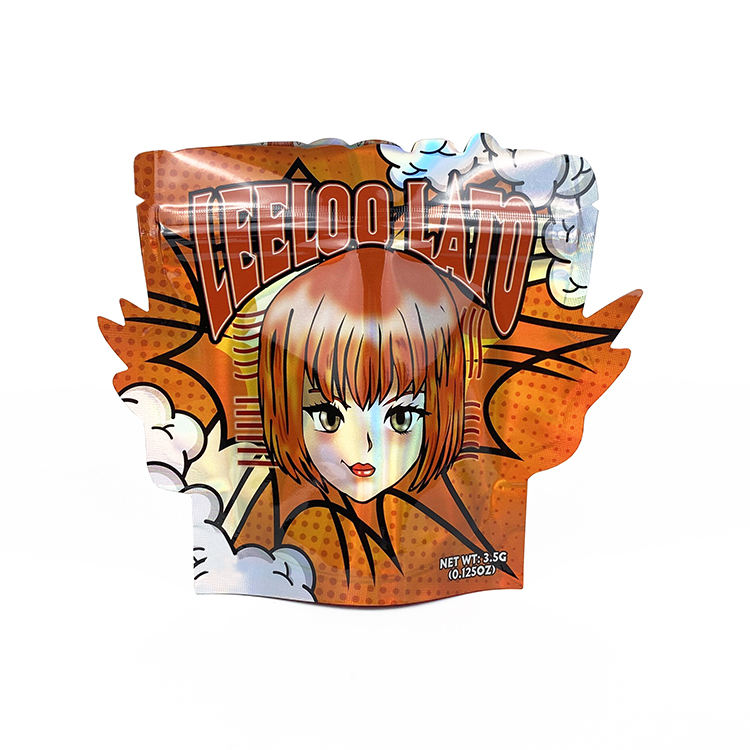
Custom Printed 3.5g Die-Cut Mylar Bags for Edibles
Custom printed 3.5g die-cut Mylar bags are resealable flexible pouches intended for portioned edible packaging. Their defining features are the stated 3.5 g fill weight, custom graphics, die-cut construction and a closure that allows the pouch to be reopened and resealed. They are relevant to cannabis brands, edible manufacturers, distributors, private-label programs and wholesale buyers managing one or multiple artwork versions.
Product Specifications
| Specification | Product detail |
|---|---|
| Packaging format | Die-cut flexible Mylar bag |
| Intended contents | Cannabis edibles |
| Stated fill weight | 3.5 g; final pouch fit must be checked against the actual edible |
| Closure | Resealable closure; exact zipper design requires confirmation |
| Printing | Custom printed; process, color requirements and artwork coverage are subject to specification |
| Shape and dimensions | Die-cut profile; finished dimensions and dieline require buyer confirmation |
| Material | Mylar flexible-film terminology; the complete laminate structure must be confirmed |
| Finish | Not specified; available appearance depends on the selected substrate and printing specification |
| Child-resistant status | Not established by resealability; any child-resistant requirement must be specified and supported separately |
| Compliance | Food-contact and destination-market requirements require confirmation before production |
What This 3.5g Edible Pouch Is Designed to Package
This format is intended for small portions of cannabis edibles rather than flower or pre-rolls. The stated 3.5 g weight describes the intended product mass, but it does not establish a universal bag size. A dense confection, an irregular gummy and a delicate coated edible can occupy very different volumes at the same weight.
Buyers should evaluate the edible’s length, width, thickness, shape, density and surface characteristics. The pouch needs enough usable internal area for filling and resealing without creating so much headspace that the product moves excessively. Products that are brittle, sticky, greasy or coated may also require different handling and material decisions.
Laminate and Barrier Decisions
The term Mylar is commonly used for polyester-based flexible packaging, but it does not by itself define the complete laminate. A pouch may be configured with multiple film layers selected for printability, stiffness, puncture resistance, heat sealability and protection from moisture, oxygen, aroma or light. Actual performance depends on the complete structure, layer thicknesses and sealing system.
For aroma-bearing edibles, an appropriate barrier laminate and properly closed seals can help contain aroma and limit external exposure. Moisture-sensitive products may need a structure selected to reduce moisture transfer, while oil-bearing or greasy edibles require an inner sealant layer compatible with the contents. Metallic or opaque layers can improve light protection, but appearance alone does not prove barrier performance. Any required OTR, MVTR, migration or product-compatibility testing must be defined and verified rather than assumed.
Die-Cut Shape, Dieline and Filling Behavior
Unlike a generic rectangular stock pouch, a die-cut bag follows a defined cutting profile. This can create a recognizable silhouette, but the shape affects usable volume, artwork area, zipper placement and seal geometry. Narrow shoulders, curved edges or decorative contours may reduce the internal space available for the edible.
The final dieline should show trim, seals, zipper location, tear or opening position, print-safe areas and any restricted zones. Buyers should also confirm whether the pouch will be hand filled or machine assisted. A visually distinctive profile can improve shelf differentiation, while a simpler profile can provide more usable area and easier filling. This is a practical trade-off between branding impact and packing efficiency.
Resealable Does Not Automatically Mean Child-Resistant
The confirmed resealable function indicates that the package can be opened and closed again, subject to the final closure design. It does not establish a tested child-resistant system. A standard press-to-close zipper, a specialized child-resistant zipper and a closure requiring a specific opening sequence are different packaging systems.
If the destination market requires child-resistant cannabis edible packaging, the buyer must specify the applicable requirement and request supporting documentation for the exact pouch construction. A tamper-evident top seal may also be considered conditionally, but heat sealing equipment, seal temperature, dwell time and pressure must match the selected inner film. A tear notch can support initial opening, although its location must not interfere with the zipper or required warning area.
Custom Printing and Multi-SKU Control
Custom cannabis edible bags can carry brand graphics, flavor or product identification, net-content statements, warning information, lot coding areas and other required copy. Final print capabilities depend on the chosen printing process, film, finish, color targets and order specification. Small type, gradients, metallic effects and registration near curved die-cut edges should be reviewed against the supplier’s artwork tolerances.
For private label multi-SKU edible pouches, maintain one approved structural dieline across compatible products where possible. Separate artwork layers can then control flavor, potency, market-specific warnings or brand variants. A version-control list should identify every SKU, artwork file, quantity and destination market to reduce the risk of printing outdated regulatory text.
Compliance and Preproduction Checks
- Confirm that the selected food-contact material is suitable for the specific edible and intended storage conditions.
- Determine whether child-resistant, tamper-evident or opaque packaging is required in the destination jurisdiction.
- Reserve adequate printable space for cannabis symbols, warnings, ingredients, allergens, nutrition information and traceability details where applicable.
- Test actual product samples in the proposed pouch to evaluate fit, grease interaction, seal contamination and handling.
- Approve the final dieline, artwork orientation, color expectations and closure position before production.
Frequently Asked Questions
Does 3.5 g determine the finished pouch dimensions?
No. The same 3.5 g weight can occupy different volumes depending on the edible’s density, shape and dimensions. The actual product and desired headspace should be reviewed before dimensions are finalized.
Are these resealable bags automatically child-resistant?
No. Resealability describes the ability to close the pouch again. Child resistance requires a suitable closure system and supporting evidence for the exact package where the destination market requires it.
Are all Mylar bags equally resistant to moisture, oxygen and aroma?
No. Barrier performance depends on the complete laminate, layer thicknesses, seals and closure. The required protection should be matched to the edible and confirmed in the final specification.
Can the die-cut shape affect filling and artwork?
Yes. Curves, narrow sections and seal areas can reduce usable volume and printable space. The dieline should be evaluated with the actual edible, filling method and mandatory label content.
What is needed to quote custom printed bags accurately?
A useful quotation request includes the edible type, 3.5 g fill weight, actual product dimensions, desired pouch dimensions, quantity, artwork versions, laminate or barrier needs, closure, finish, filling method, destination market and applicable compliance requirements.
Request a Product-Specific B2B Quotation
For an RFQ, provide the edible format and actual dimensions, target 3.5 g fill, proposed pouch size or sample, total quantity, quantity by artwork version, preferred die-cut profile, barrier priorities, resealable or child-resistant closure requirement, finish, filling method and destination market. A wholesale cannabis packaging supplier can then evaluate the dieline, laminate, printing and closure as one coordinated specification rather than quoting from fill weight alone.

Reviews
There are no reviews yet.