
Custom Printed Fishing Lure Packaging Bags for B2B Programs
Custom printed fishing lure packaging bags are flexible retail or distribution packs made to present, identify, and contain fishing lures or related bait products. They are relevant to lure brands, private-label buyers, tackle distributors, wholesalers, importers, and businesses managing several product designs. The final bag must be specified around the lure type, hook configuration, dimensions, packaging process, display method, and destination-market requirements.
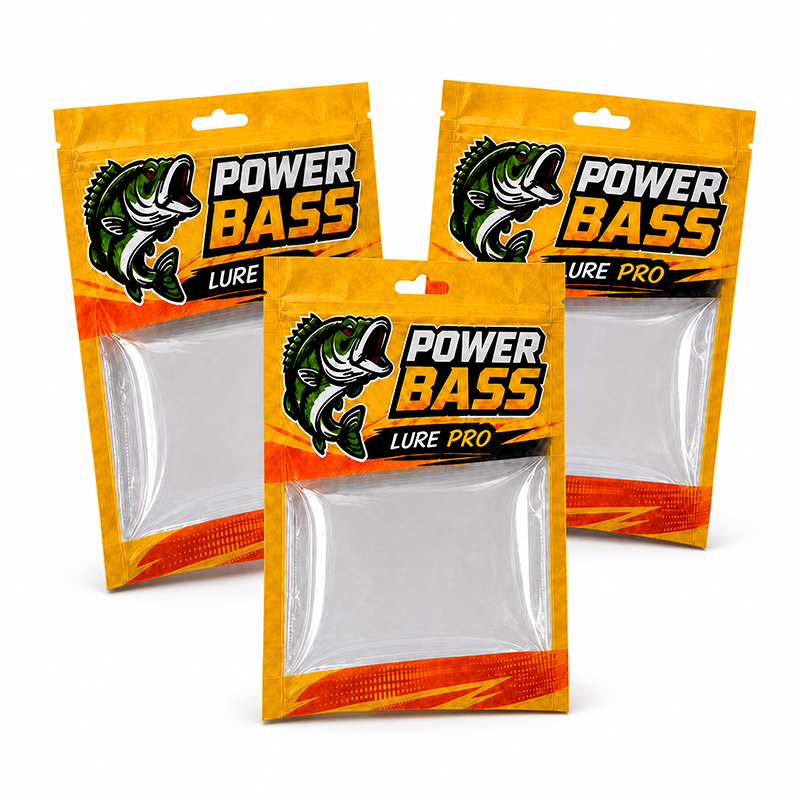
Product Specifications
| Product type | Custom printed flexible packaging bags for fishing lures |
|---|---|
| Intended contents | Fishing lures or related bait products; exact suitability depends on lure construction and formulation |
| Bag dimensions | To be confirmed from the lure dimensions, hook profile, required headspace, and filling method |
| Material structure | To be selected according to puncture, seal, moisture, light, aroma, and chemical-compatibility requirements |
| Pouch format | Flat, gusseted, hanging, resealable, or other configurations may be evaluated subject to the final specification |
| Closure | Zipper, heat-sealed opening, or another closure may be configured; required opening behavior must be confirmed |
| Printing | Custom graphics and multi-SKU artwork, subject to the approved material, printing method, and die line |
| Finish and visibility | Clear, matte, gloss, metallic-looking, or other appearances may be considered where compatible with the selected structure |
| Quotation status | Quantity, artwork count, dimensions, material, closure, finish, testing needs, and destination market require confirmation |
Match the Bag to the Lure, Not Only the Stated Pack Size
A hard-bodied crankbait, a spoon, a jig, and a soft plastic bait create different packaging demands. Overall length alone is insufficient because treble hooks, wire arms, bills, skirts, and irregular bodies can reduce usable space or concentrate force against the film. Buyers should provide the actual product dimensions and identify its widest, thickest, and sharpest points.
Soft baits may contain oils, scents, plasticizers, salts, or other ingredients that interact differently with packaging layers and inks. Compatibility should therefore be confirmed using the actual packed product. For wet, scented, or formulated bait, buyers should disclose the contents rather than assume that general-purpose printed fishing bait pouches will provide suitable long-term contact performance.
Laminate Selection and Puncture Risk
Flexible laminate lure bags can be configured with different film combinations, but appearance does not establish performance. Puncture resistance depends on the complete laminate, thickness distribution, pouch geometry, hook protection, and handling conditions. A stronger structure can improve resistance to hook points and abrasion, although it can also increase stiffness, material use, and cost.
Moisture, oxygen, aroma, and light protection also depend on the full packaging and sealing system. A barrier layer may help limit environmental exposure or contain scent when properly sealed, but the appropriate requirement varies between dry hard lures and scented soft bait. Hooks should not be allowed to press directly against an unsupported seal area. An internal tray, hook guard, backing card, or other restraint may be considered when the lure presents a high snag or puncture risk.
Pouch Style, Headspace, and Retail Display
Protective fishing tackle packaging must provide enough usable internal area for loading without leaving excessive movement. Too little headspace can place pressure on seals or make automated and manual filling difficult. Too much headspace can allow the lure to shift, reducing presentation consistency and increasing contact between hooks and the bag.
A flat pouch can suit slim products and provides two primary printable panels. A gusseted format can create more usable volume for thicker tackle, but it changes the die line, artwork placement, and shelf behavior. A hanging hole may be configured for peg display if the pouch structure and top seal area support it. The buyer should confirm the peg style, loaded weight, hole position, and required distance between the product and the top seal.
Closure and Tamper-Evidence Decisions
A heat-sealed opening provides a visible initial seal when correctly specified and processed. A zipper can add convenient reclosure after opening, particularly for multi-piece bait packs, but an ordinary resealable zipper is not automatically tamper-evident. A zipper also requires sufficient space above and below the closure for sealing, opening, and artwork clearance.
The selected closure must suit the filling process. Manual loading, semi-automatic packing, and automated filling may require different opening widths, film stiffness, seal areas, and bag presentation. Tear notches can support controlled opening, subject to their position relative to the zipper, hanging hole, and graphics.
Custom Printing and Multi-SKU Control
Custom fishing graphics can identify lure pattern, color, model, action, depth range, quantity, warnings, and other buyer-supplied information. Available print coverage and color reproduction depend on the substrate, printing process, finish, and seal geometry. Fine text, barcodes, and variable product details should be reviewed at final size rather than judged only from an enlarged screen proof.
OEM multi-SKU bait packaging benefits from a controlled master layout. Shared logo placement, information hierarchy, color standards, and fixed regulatory panels can improve consistency while designated areas differentiate lure variants. Each artwork version should have a unique file name and revision approval to reduce the risk of pairing the wrong bag with a lure.
Visibility Versus Protection: A Practical Trade-Off
A clear panel can help buyers inspect lure color, shape, and hook arrangement without opening the bag. The trade-off is that transparent areas generally provide less light screening than an opaque construction. Metallic-looking or opaque artwork can improve visual coverage, but it hides the packed product. Buyers should decide whether product visibility or greater light screening is more important and then confirm the corresponding laminate rather than choosing by appearance alone.
Compliance and Validation Before Production
Required labels, warnings, language, recycling marks, product claims, and importer information vary by destination market and sales channel. Packaging buyers remain responsible for supplying approved copy and identifying applicable requirements. If the bag will directly contact a formulated soft bait, request material documentation relevant to that use and market. Compatibility, seal integrity, hanging performance, barcode readability, and packed-product trials should be agreed according to the actual application; no compliance or performance status should be inferred from the product name alone.
Frequently Asked Questions
How should I determine the bag size for a fishing lure?
Measure the lure’s overall length, width, thickness, hooks, bill, wire arms, and other projections. Then allow practical loading space, closure clearance, seal areas, and controlled headspace. The stated lure length alone does not establish the finished bag dimensions.
Can these bags package both hard lures and soft baits?
They may be configured for either application, but one structure should not be assumed suitable for every product. Hard lures emphasize hook restraint and puncture resistance, while soft baits may require additional chemical, oil, scent, or moisture compatibility review.
Does a thicker film guarantee that hooks will not puncture the bag?
No. Thickness is only one factor. Laminate construction, hook sharpness, internal movement, restraint components, seal geometry, packed weight, and distribution handling all affect puncture performance.
Can the bag include a zipper and a hanging hole?
These features may be combined if the bag dimensions and top-section layout provide enough room for the hanging hole, closure, opening area, seals, and artwork. Their final positions must be confirmed on the die line.
What information is needed for a multi-SKU quotation?
Provide the lure type, actual product dimensions, desired bag dimensions, total quantity, quantity per artwork, number of artwork versions, material or barrier needs, closure, display format, finish, filling method, destination market, and any testing or documentation requirements.
Request a Product-Specific B2B Quotation
For an RFQ from a wholesale fishing lure packaging supplier, submit the lure or bait description, product dimensions, hook configuration, desired pouch dimensions, quantity, artwork versions, preferred material or required barrier function, closure, hanging requirement, finish, visibility preference, filling method, destination market, and applicable compliance needs. A physical product sample or dimensioned drawing can help evaluate usable space, seal clearance, and puncture exposure before the final specification is approved.
Reviews
There are no reviews yet.