
Custom Paperboard Counter Display Boxes for Rolling Accessories
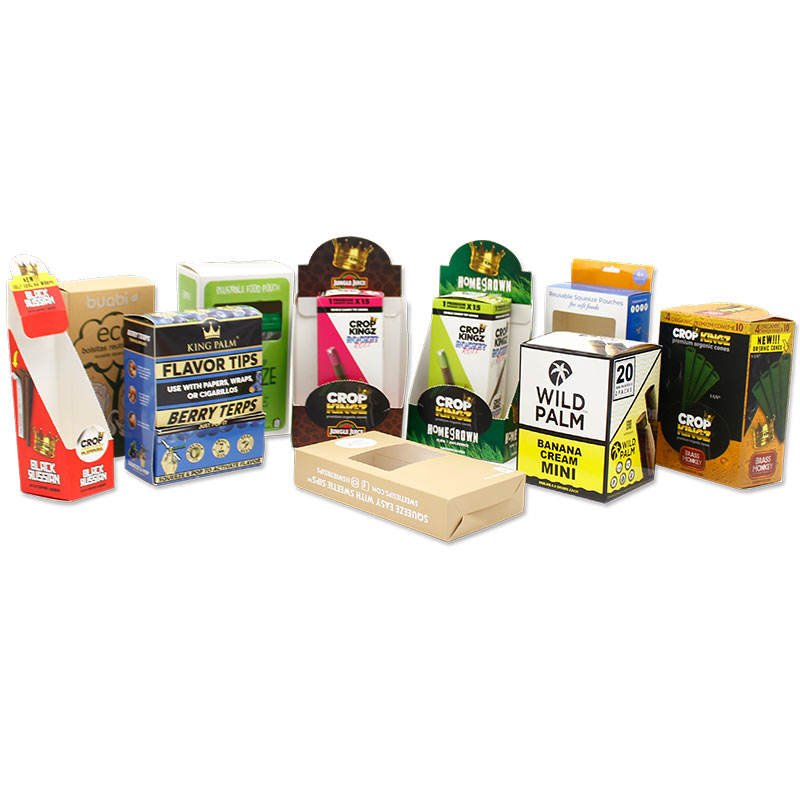
Custom paperboard counter display boxes are printed retail display cartons designed to organize, present, and promote rolling accessories at dispensary counters, smoke shops, distributor shelves, and checkout areas. This product is intended for B2B cannabis accessory brands, wholesalers, private-label programs, and multi-SKU buyers that need a compact branded display for rolling papers, cones, tips, filters, wraps, lighters, trays, or similar small packaged accessories. The confirmed product is a paperboard counter display box; final size, board thickness, print method, finish, insert layout, and accessory fit must be confirmed before quotation.
Product Specifications
| Product type | Paperboard counter display box for rolling accessories |
|---|---|
| Intended contents | Rolling papers, cones, filter tips, wraps, small smoking accessories, or retail-ready accessory packs, subject to final fit testing |
| Material | Paperboard; grade, thickness, recycled-content option, and coating are selected according to load, print, and market requirements |
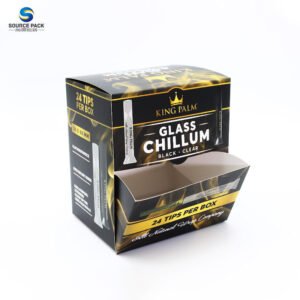
| Display format | Countertop retail display; header card, open-front tray, dividers, or inserts may be configured if required |
| Customization | Custom dimensions, dieline, artwork, color, logo placement, finish, and multi-SKU graphics can be specified |
| Printing | Custom printed surface can be configured; exact printing method and color target depend on artwork and production specification |
| Finish options | Matte, gloss, soft-touch, spot effects, foil effects, or other finishes may be considered depending on selected board and artwork |
| Compliance details | Buyer should confirm destination-market labeling, warnings, claims, barcode placement, and retail display rules |
What This Display Box Is Built to Do
Paperboard display packaging for rolling accessories is different from a simple shipping carton. Its job is to hold small retail units upright, show the brand clearly from the counter, and keep frequently handled products orderly while staff and customers view the selection. For rolling papers and tips, a shallow display can improve front-facing presentation. For cones, wraps, and mixed accessory packs, the internal width, pocket depth, and headspace affect whether products lean, bend, or fall forward.
Because rolling accessory SKUs vary widely in length, thickness, and retail pack count, a stated accessory type does not create one universal box size. Buyers should provide the actual product dimensions, number of units per display, pack orientation, and whether the display must support single-SKU or assorted-SKU merchandising.
Paperboard Structure, Stiffness, and Retail Handling
Paperboard is commonly selected for countertop retail display boxes because it offers printability, foldability, and a clean merchandising appearance. The correct board specification depends on the load of the accessories, the height of the back panel, the size of the base tray, and how often the display will be handled. A taller header may require stronger board, locking tabs, or structural reinforcement to reduce bowing. A heavy assortment of cones, lighters, or boxed accessories may require a more rigid tray than a lightweight rolling paper display.
For buyers comparing paperboard with flexible films or laminated pouches, the decision is functional. Flexible materials such as the options summarized in our packaging material comparison are useful when aroma, moisture, puncture resistance, or sealability are central requirements. A paperboard counter display box is primarily a presentation and organization format. If the rolling accessories themselves require aroma containment, moisture control, or tamper evidence, those functions usually need to be addressed by the primary package placed inside the display.
Custom Printing, Artwork Area, and Brand Consistency
Custom printed rolling paper display boxes give cannabis accessory brands space for logo placement, strain-family color systems, product names, QR codes, barcodes, warning panels, and wholesale account-specific layouts. The most visible zones are usually the header, front lip, side panels, and interior back wall. Artwork should be prepared on the final dieline because folds, tuck flaps, locking tabs, and cut lines can interrupt important copy if they are not considered early.
Finish selection should support both appearance and use. A matte finish can reduce glare and provide a premium retail look, while gloss may increase color vibrancy. Spot varnish, metallic effects, or foil-style decoration may emphasize brand marks, but these effects can affect cost, recyclability goals, and artwork tolerance. If sustainability positioning is important, discuss board selection, coatings, ink coverage, and recyclability expectations rather than assuming every printed paperboard display meets the same environmental requirement.
Multi-SKU and Private Label Display Planning
Private label accessory display packaging often needs a repeatable structure that can carry many artwork versions. A single dieline can sometimes support different flavors, paper sizes, cone counts, wrap types, or regional warning layouts, provided the product dimensions are consistent. When pack sizes vary, buyers may need separate inserts, divider depths, or display footprints to prevent loose movement and uneven shelf presentation.
For OEM and wholesale cannabis accessory display boxes, consistency across SKUs is a procurement advantage. Confirm whether the goal is one master display structure with multiple printed graphics, a family of related sizes, or a modular counter program for mixed accessories. Our private label packaging information can help buyers frame artwork version control, brand architecture, and specification repeatability for multi-SKU programs.
Fit, Filling Behavior, and a Key Trade-Off
The main trade-off in countertop retail display boxes is between tight product control and easy product removal. A snug pocket or narrow tray keeps rolling papers and filter tips upright, but it may make restocking slower or cause friction on printed retail packs. A looser tray improves filling and customer access, but products may lean, rotate, or look untidy as inventory is removed. The best specification depends on the retail environment, unit weight, pack stiffness, and whether the display is meant for staff-assisted sales or self-service counter access.
For efficient packing, confirm whether displays will be shipped flat and assembled later, pre-assembled, or packed with accessories already loaded. This affects lock design, glue requirements, carton strength, and the acceptable amount of manual assembly. If the display must sit inside a master shipping carton, the outer shipping configuration should be planned with the display footprint from the beginning.
Compliance and Retail Information to Confirm
Rolling accessories may be regulated differently by destination market and sales channel. The display itself may need room for age-related messaging, ingredient or material claims for the accessories, recycling symbols, legal disclaimers, retailer codes, or scannable labels. Avoid placing required warnings only on removable header cards unless the destination rules allow it. For cannabis-adjacent packaging, buyers should review local requirements and may find the overview on cannabis packaging compliance useful when preparing label content for review.
Do not treat a paperboard display as child-resistant packaging unless a separate tested and compliant child-resistant primary package is specified. Likewise, paperboard alone should not be described as smell proof, moisture proof, or high barrier. Those performance claims depend on the complete primary package, materials, closures, and seals used for the actual product inside the display.
Custom Development Process
- Requirements review: Share the rolling accessory type, unit dimensions, display quantity, retail orientation, destination market, and branding goals.
- Specification confirmation: Confirm the paperboard grade, display footprint, dieline, header height, inserts or dividers, print coverage, finish, and packing method.
- Sample review: Review a structural sample or printed sample option as applicable to check product fit, counter stability, artwork placement, and assembly behavior.
- Bulk-production approval: Approve the final dieline, artwork files, color expectations, material specification, and packing instructions before bulk production proceeds.
FAQ: Custom Paperboard Counter Display Boxes
Can these display boxes be used for different rolling accessory SKUs?
Yes, they can be configured for single-SKU or multi-SKU programs, but each accessory pack must be checked for length, width, thickness, weight, and retail orientation before the dieline is finalized.
Is paperboard enough to protect rolling papers or cones from moisture and odor?
Paperboard display boxes mainly provide presentation and organization. Moisture, aroma, oxygen, or odor-control performance should be handled by the primary packaging around the rolling papers, cones, or accessories.
Can the display include a header card and internal dividers?
A header card, open-front tray, dividers, or inserts may be configured depending on the product dimensions, desired display angle, print layout, and packing method.
What artwork details should be prepared before requesting a quote?
Prepare the logo, color references, barcode or QR code needs, warning text, retail claims, artwork versions, and any required destination-market information. Final placement should be checked on the approved dieline.
Can one structure support private-label or OEM artwork versions?
Often, one structure can support multiple private-label graphics if the accessory dimensions and display count remain the same. If the products vary in size or weight, separate structures or inserts may be needed.
RFQ Checklist for B2B Buyers
To request a product-specific quotation for custom paperboard counter display boxes, provide the accessory type, actual product pack dimensions, desired number of units per display, display footprint target, single-SKU or mixed-SKU plan, artwork versions, paperboard and finish preference, header or divider requirements, filling and assembly method, destination market, compliance text needs, and estimated order quantity. These details help confirm whether the display should prioritize rigidity, fast assembly, premium print appearance, compact counter footprint, or multi-SKU flexibility.


Reviews
There are no reviews yet.