
Custom Printed Child-Resistant Stand-Up Mylar Pouches for Cannabis Packaging
Custom printed child-resistant stand-up Mylar pouches are flexible cannabis packaging bags with a gusseted base, a printable exterior, and a child-resistant opening system specified for the finished package. They are intended for B2B buyers packaging products such as cannabis flower, edibles, or other dry goods, subject to the selected dimensions, laminate, closure, and destination-market requirements. Cannabis brands, distributors, wholesalers, private-label programs, and multi-SKU buyers should confirm the complete construction before requesting a quotation.
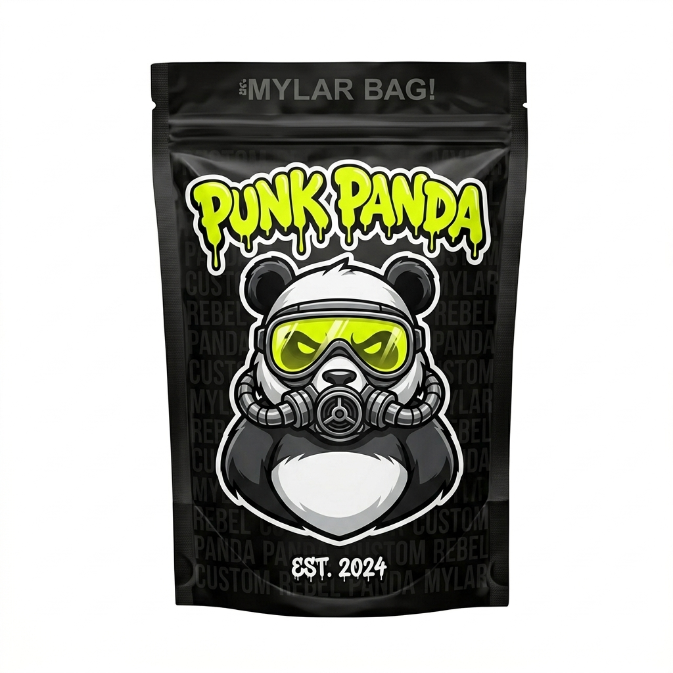
Product Specifications
| Product type | Stand-up flexible pouch with a child-resistant closure configuration |
|---|---|
| Stated material | Mylar pouch; the complete laminate structure requires confirmation |
| Printing | Custom printed exterior; artwork process, print method, and print limits require confirmation |
| Intended B2B use | Cannabis product packaging, including dry products; confirm suitability for the actual contents |
| Size and capacity | Custom or selected dimensions, usable volume, and fill weight require confirmation |
| Closure | Child-resistant configuration; testing, standard, and operating instructions require confirmation |
| Finish | Selected finish, such as matte or gloss, requires confirmation |
| Order program | Quantity, artwork versions, sampling, and production terms require confirmation in the RFQ |
How the Stand-Up Pouch Fits the Product
The bottom gusset allows the pouch to stand during filling, storage, display, and case packing. It also affects internal shape and usable volume. A pouch that looks large enough externally may not provide the right fill height once seals, the closure, and headspace are considered. For flower, density and nug size influence how much product fits without excessive compression. For edibles, the product dimensions, grease, moisture, and serving configuration should guide the pouch selection. A stated fill weight alone does not establish one universal pouch size.
Tell the supplier the actual product dimensions, target fill weight, desired headspace, and filling method. Manual filling, semi-automatic filling, and automated equipment can require different opening widths and pouch tolerances. The gusset and seal geometry should also be reviewed for stable standing, clean presentation, and adequate space above the product.
Mylar Structure, Barrier, and Seal Decisions
“Mylar” identifies the requested pouch material language, but appearance alone does not define the complete barrier construction. Depending on the selected laminate structure, the pouch may be configured to help protect contents from moisture, oxygen, aroma transfer, light, and handling damage. The complete film combination, thickness, sealant layer, and sealing conditions determine practical performance; these details should be confirmed rather than assumed from a metallic, matte, or glossy appearance.
A suitable barrier can help contain aroma and preserve product condition when the pouch is correctly filled and sealed. However, “smell resistant” should be treated as a performance objective requiring specification and testing, not as an unconditional permanent guarantee. A clear window may improve product visibility but can reduce light protection in that area. A more rigid structure may improve standing and puncture resistance while affecting foldability, seal behavior, or cost. Ask for the proposed laminate, barrier targets if applicable, seal temperature range, and any available test documentation for the intended contents and market.
Child-Resistant Closure and Opening Controls
The product is identified as child-resistant, but a regular resealable zipper should not automatically be treated as a tested child-resistant closure. Confirm the exact opening mechanism, applicable test standard, test status, operating instructions, and whether the evidence applies to the final pouch size, material, artwork, and closure combination. The closure must be practical for the intended adult user while remaining properly engaged after opening and reclosing.
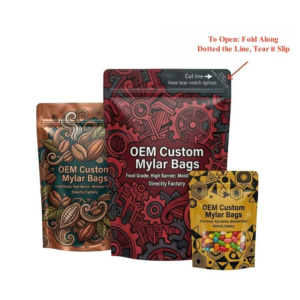
A heat seal can provide an additional tamper-evident or initial-seal function when specified, but it does not by itself establish child resistance. Ask whether the production format includes a tear notch, the position of the first opening, and the required seal area. These choices affect accessibility, filling speed, package appearance, and the amount of usable artwork space.
Custom Printing and Multi-SKU Programs
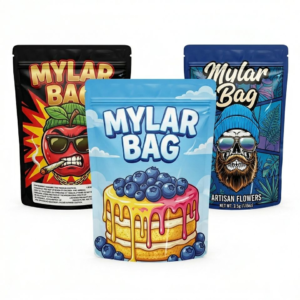
Custom printed cannabis Mylar bags allow a brand to coordinate strain, flavor, potency, product type, and regulatory artwork across a pouch range. Before artwork production, confirm the dieline, safe area, bleed, seal exclusion zones, closure clearance, gusset distortion, barcode placement, and any required warning or compliance panel. Artwork should be prepared for the selected substrate and print process because color, metallic effects, white ink, fine text, and gradients can reproduce differently across structures and finishes.
For private-label weed pouches and multi-SKU programs, define how many artwork versions are required and whether all versions share one pouch size and construction. Consistent dimensions can simplify filling and secondary packaging, while different products may still require different headspace, barrier, or opening specifications. Confirm version control, proof approval, color expectations, and the treatment of variable information before production planning.
Destination-Market Review Before Ordering
Cannabis packaging requirements vary by destination market and product category. The buyer should identify the jurisdiction, product type, required warnings, labeling language, child-resistant expectations, tamper-evident requirements, food-contact considerations for edibles, and any restrictions on imagery or claims. The printed pouch should not be treated as compliant merely because it has a child-resistant feature or cannabis-oriented artwork. Request the documentation and testing relevant to the final configuration and intended market, then have the responsible compliance team review the finished artwork.
RFQ Information Buyers Should Prepare
A complete RFQ helps a cannabis packaging manufacturer or wholesale supplier recommend a workable construction instead of quoting an unsuitable generic bag. Include the product contents, actual fill weight, product dimensions, density where relevant, desired pouch dimensions, target headspace, quantity, number of artwork versions, laminate or barrier preference, closure type, tear-notch requirement, finish, filling method, and destination market. Also state whether the pouch will receive a heat seal, whether it needs a window, and what compliance or test documentation must be reviewed.
Frequently Asked Questions
Are these pouches suitable for cannabis flower?
They can be evaluated for cannabis flower packaging, but the correct size depends on flower density, nug dimensions, fill weight, headspace, closure, and the selected barrier structure. Confirm the final dimensions and filling method before ordering.
Does Mylar automatically make the pouch odor-proof?
No. The complete laminate, sealant, closure, and sealing process affect aroma containment. The pouch may help contain aroma when properly specified and sealed, but any smell-resistant performance claim should be confirmed for the final construction.
Is the child-resistant zipper already certified?
The product is identified as child-resistant, but certification or test status is not established by the product name alone. Confirm the applicable standard, test evidence, instructions, and whether they apply to the finished pouch configuration.
Can one pouch size support several cannabis SKUs?
One size may support multiple SKUs when their fill weights, product dimensions, density, headspace, and closure requirements are compatible. Validate each SKU rather than relying only on nominal weight.
What artwork information is needed for a quote?
Provide the number of artwork versions, desired finish, logo and color requirements, warning or regulatory panels, barcode placement, and any clear-window request. The supplier should confirm the dieline, printable area, seal exclusions, and substrate limits.
Request a B2B Specification Review
For an RFQ, send the contents, fill weight or actual product dimensions, desired pouch dimensions, quantity, artwork versions, material or barrier preference, child-resistant closure requirements, finish, filling method, destination market, and compliance needs. These details allow the proposed custom printed child-resistant stand-up Mylar pouches to be reviewed for fit, sealing, artwork, and procurement suitability before production.
Reviews
There are no reviews yet.