
Custom Printed Child-Resistant Holographic Mylar Bags for Cannabis Brands
Custom printed child-resistant holographic Mylar bags are flexible cannabis packaging bags that combine a holographic appearance with custom branding and a child-resistant bag format. They may suit cannabis flower, pre-rolls, edibles, or other regulated products when the selected size, laminate, closure, seal design, and destination-market requirements match the application. They are intended for cannabis brands, distributors, private-label and OEM buyers, wholesalers, and multi-SKU programs that need a distinctive printed package rather than an unbranded stock bag.
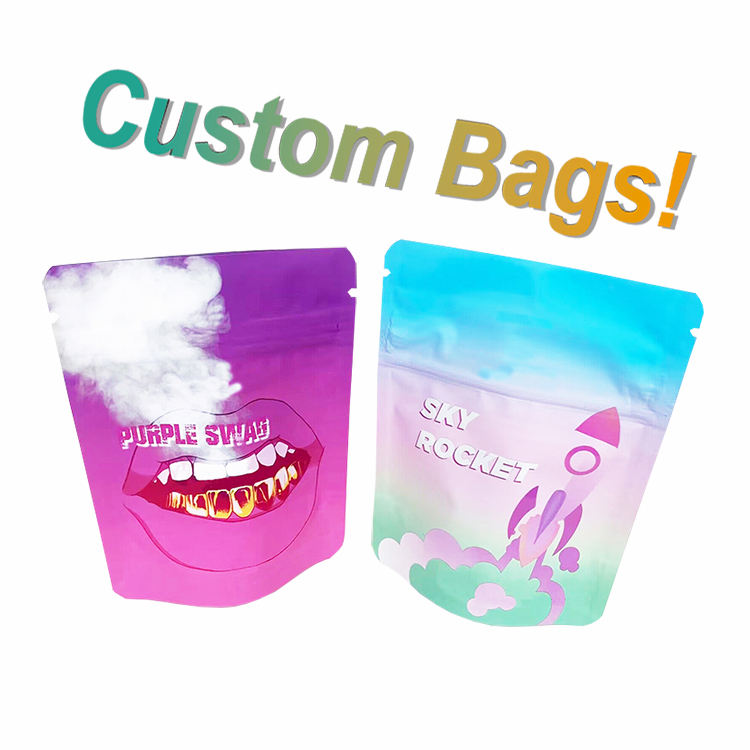
Product Specifications
| Product type | Flexible custom cannabis packaging bag |
|---|---|
| Appearance | Holographic finish or holographic visual effect |
| Printed design | Custom printing; artwork, print area, colors, and substrate limits require confirmation |
| Closure and opening | Child-resistant bag format; closure construction, operating method, and testing documentation require confirmation |
| Material | Mylar bag structure; the complete laminate and barrier layers require confirmation |
| Bag size and fill | Dimensions, usable volume, fill weight, product density, and headspace are application-specific |
| Intended buyers | Cannabis brands, distributors, wholesalers, private-label/OEM buyers, and multi-SKU purchasers |
| Commercial details | MOQ, pricing, samples, lead time, inventory, and delivery require an RFQ |
How the Holographic Mylar Structure Affects Packaging Performance
“Mylar” is commonly used in packaging searches to describe a flexible film bag, but the commercial name alone does not identify the complete laminate. Ask for the actual layer structure before approving the bag for a sensitive cannabis product. Depending on the selected structure, barrier layers can help limit the transfer of aroma, moisture, oxygen, and light. Proper heat sealing also matters because a high-barrier film cannot compensate for an incomplete, contaminated, or poorly formed seal.
The holographic effect is primarily an appearance choice. It can create visual depth, reflective detail, or a premium shelf presentation, but holographic appearance does not by itself prove a specific oxygen-transmission rate, moisture-vapor-transmission rate, odor barrier, puncture resistance, or light-blocking performance. A buyer should request the intended barrier structure and sealing conditions if aroma retention, moisture control, or extended storage is important.
There is a practical trade-off between visual effect and print control. A strong holographic pattern can compete with small text, fine linework, or regulated label information. Artwork should therefore be reviewed against the holographic area, white-ink strategy, contrast, metallic or reflective effects, and the required warning or product information. The final print result also depends on the selected substrate and printing process.
Choose Size Around the Product, Not Only the Fill Weight
A stated cannabis fill weight does not establish one universal bag size. Flower density varies by cultivar, grind, moisture condition, and handling, so the same nominal weight may require different internal volume. Confirm the actual product dimensions, density, desired headspace, and whether the bag must stand, lie flat, or accommodate a secondary insert.
For flower, headspace affects filling speed, compression, aroma containment, and the appearance of the finished pack. Excess headspace can make the pouch look underfilled and allow movement during distribution; insufficient headspace can interfere with closing and sealing. For pre-rolls, confirm each pre-roll’s length and diameter, the number per bag, internal movement, and crush risk. For edibles, review the product’s moisture and grease characteristics, serving information, resealability, and any applicable food-contact requirements before finalizing the structure.
Child-Resistant Closure and Seal Decisions
The product is described as child-resistant, but the exact closure mechanism and supporting documentation must be confirmed for the destination market. An ordinary resealable zipper should not automatically be described as a tested child-resistant closure. Ask whether the selected design uses a specialized child-resistant opening feature, whether the bag is intended to be heat sealed after filling, and what evidence is available for the applicable market and product configuration.
A heat seal can provide a controlled tamper-evident or permanent seal when the sealing equipment, temperature, dwell time, pressure, and film structure are matched correctly. A zipper may support repeated opening, while a heat seal can require a separate opening step. If the bag combines both, confirm whether the child-resistant function applies before sealing, after sealing, or to the resealable opening. These details affect filling workflow, consumer access, and packaging-line validation.
Custom Printing, Artwork, and Multi-SKU Consistency
Custom printed cannabis packaging bags can carry strain names, product variants, brand graphics, regulatory text, batch information, and SKU-specific identifiers. Before artwork approval, confirm the usable print area, seal zones, tear-notch position, opening position, holographic coverage, color requirements, and any areas that must remain unprinted. Important text should not be placed where a fold, gusset, closure, or heat seal can distort or hide it.
For private-label, OEM, and multi-SKU programs, create one approved specification for the common bag structure and a controlled artwork system for each variant. Confirm whether all SKUs use the same dimensions, laminate, closure, finish, and seal geometry. If strain or flavor versions use different fill weights, do not assume that one layout or one internal volume will work equally well. Request a proof or physical sample when holographic effects, small text, color matching, or exact die-line placement is important.
Destination-Market and Procurement Checks
Cannabis packaging requirements vary by destination, product category, and jurisdiction. Before production, the buyer should identify the market, contents, warning and labeling obligations, child-resistant expectations, tamper-evidence needs, recycling or disposal considerations, and any food-contact requirements for edible products. The package artwork and selected materials should be reviewed against those requirements by the responsible brand, compliance team, or local adviser.
For an efficient RFQ, provide the intended contents, fill weight or actual product dimensions, desired bag dimensions, quantity by SKU, artwork versions, required laminate or barrier target, closure preference, holographic and other finish requirements, filling method, destination market, and compliance documentation needs. Also ask the supplier to confirm production tolerances, sealable areas, sample approval steps, and which technical documents are available for the proposed structure.
Frequently Asked Questions
Are these bags suitable for cannabis flower?
They may be suitable for cannabis flower when the internal volume, headspace, laminate, closure, and sealing method are matched to the flower’s density and storage requirements. Confirm the actual fill weight and desired bag dimensions rather than selecting by weight alone.
Does the holographic finish make the bag light-proof or smell-proof?
No. Holographic appearance does not establish light, aroma, oxygen, or moisture performance. Those properties depend on the complete laminate, closure, and seal quality. The selected structure may help contain aroma and protect contents when properly sealed, but the supplier should confirm the technical specification.
Is the zipper automatically child-resistant?
No. An ordinary resealable zipper should not be treated as a tested child-resistant closure. Confirm the closure design, operating method, and destination-market testing or documentation before approval.
Can one bag specification support several cannabis SKUs?
Possibly, if the products have compatible dimensions, fill volumes, closure requirements, and artwork layouts. Different densities, product formats, or fill weights may require different sizes or headspace. Review every SKU before consolidating specifications.
What should a buyer include in a quotation request?
Include the contents, fill weight or product dimensions, desired bag dimensions, quantity by artwork version, material or barrier requirements, closure, finish, filling method, destination market, and compliance-documentation needs. Ask for confirmation of the final structure, seal area, tolerances, samples, MOQ, pricing, lead time, and delivery terms.
Request a Product-Specific RFQ
To evaluate these holographic child-resistant weed pouches for your program, send the contents, fill weight or actual product dimensions, desired pouch dimensions, quantity, artwork versions, material or barrier requirements, closure preference, holographic finish details, filling method, destination market, and compliance needs. The supplier can then confirm the appropriate bag configuration and commercial details for your private-label, OEM, wholesale, or multi-SKU order.

Reviews
There are no reviews yet.