
Custom Printed 7g Cookie Mylar Pouches for B2B Edible Packaging
Custom printed 7g cookie Mylar pouches are flexible stand-up bags intended for a stated 7-gram cookie fill and branded retail presentation. They are relevant to cannabis edible brands, private-label programs, distributors, wholesalers, and multi-SKU buyers that need custom graphics on a pouch format with a bottom gusset. The 7g designation identifies the intended fill weight, but it does not establish universal pouch dimensions: cookie diameter, thickness, density, wrapping, and required headspace must be evaluated before production.
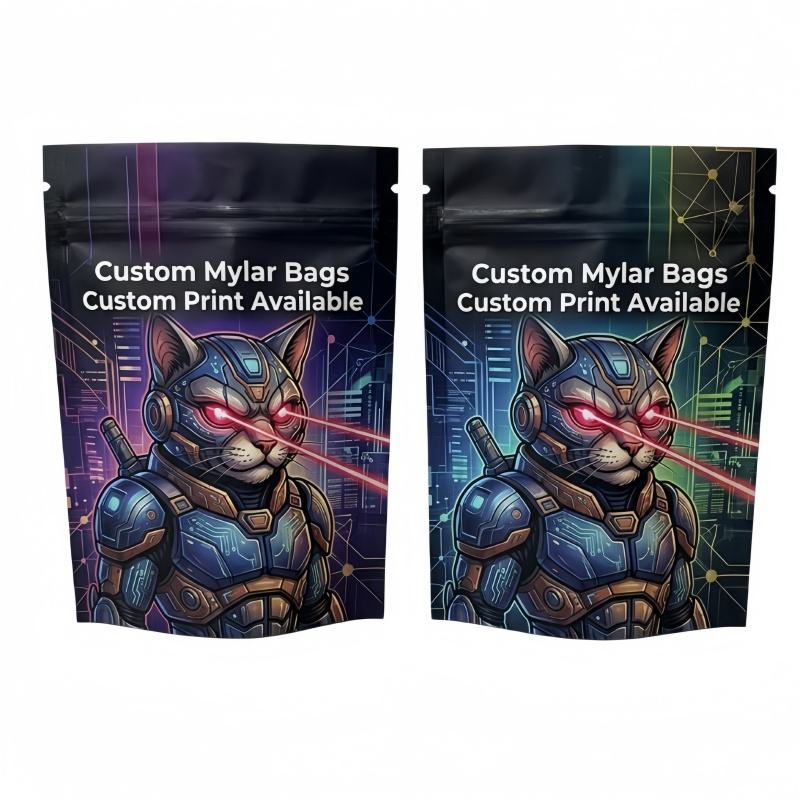
Product Specifications
| Specification | Product detail |
|---|---|
| Product type | Custom-printed flexible cookie pouch |
| Stated fill weight | 7g; final fit depends on the physical cookie |
| Pouch format | Stand-up pouch with a bottom gusset |
| Material description | Mylar-type flexible packaging; the complete laminate structure must be confirmed |
| Printing | Custom printing; artwork process, color requirements, coverage, and finish are subject to specification |
| Intended contents | Cookies, including cannabis edible cookies where permitted and appropriately specified |
| Closure | Not stated; zipper, heat-seal area, and any child-resistant requirement must be confirmed |
| Dimensions | Not provided; determine from cookie measurements, headspace, filling method, and seal geometry |
| Barrier performance | Depends on the complete laminate, closure, and seal integrity |
| Compliance status | Must be assessed for the contents, destination market, and selected specification |
How a 7g Cookie Determines the Required Pouch Size
A stated 7g weight is not enough to select bag dimensions. Two cookies with the same weight can have different diameters, thicknesses, densities, toppings, or individual wraps. Buyers should provide the actual cookie diameter, maximum thickness, and whether the product is inserted loose, wrapped, or placed on a support card.
The stand-up bottom gusset expands as the pouch is filled. This can improve shelf presentation, but the gusset also affects usable internal volume and filling behavior. Adequate headspace is needed so crumbs, grease, or product edges do not contaminate the sealing area. Excessive headspace, however, can allow more internal movement and may make a single cookie look undersized. Physical fit testing is therefore more reliable than selecting 7g stand-up Mylar cookie bags by fill weight alone.
Laminate, Freshness, and Product Protection
“Mylar” is commonly used in the market to describe high-barrier flexible pouches, but the name alone does not define every layer or performance value. A pouch can be configured with a multilayer laminate selected for stiffness, puncture resistance, printability, and heat sealability. Exact films, layer thicknesses, adhesives, and sealant materials must be agreed in the specification.
Barrier performance comes from the entire packaging system. Depending on the laminate, the pouch may help limit moisture and oxygen transfer, protect the cookie from light, and contain aroma when properly sealed. The zipper and final top seal also affect odor control and shelf-life performance. No oxygen-transfer rate, moisture-vapor transmission rate, shelf life, or permanent smell-proof result should be assumed without supporting test data for the final structure.
A metallic or opaque layer can provide stronger light protection than a clear viewing window, while a window allows buyers to see the cookie. That visibility creates a real trade-off: it may support merchandising but reduces light shielding in the window area. Greasy or high-moisture cookies may also require a different food-contact sealant and barrier specification than dry cookies.
Zipper, Heat Seal, and Child-Resistant Requirements
A resealable zipper may be configured to support repeated opening after sale, but an ordinary zipper is not automatically child-resistant. If the destination market requires child-resistant cannabis cookie packaging pouches, the closure and complete package should be specified for the applicable protocol and market. Evidence relating to the selected design should be reviewed rather than inferred from its appearance.
A tamper-evident retail configuration may include a heat-seal area above the zipper, subject to the final pouch design. Tear notches can assist opening after that top seal is removed. Buyers should confirm whether pouches will be sealed manually or by equipment because seal-bar width, temperature range, dwell time, and keeping crumbs out of the seal area affect production consistency.
Custom Printing and Multi-SKU Artwork
These custom printed edible bags can carry brand graphics, flavor or strain identification, net-content statements, warnings, ingredients, nutrition or serving information, batch areas, and other required copy when incorporated into the approved artwork. The actual printable area depends on the pouch dimensions, gusset, zipper position, seals, tear notch, and selected printing process.
Matte, gloss, metallic, or other visual effects may be available depending on the substrate and print specification, but appearance does not prove barrier performance. For private label 7g cookie pouches, buyers should establish a shared die line, color references, logo placement, and fixed regulatory zones across artwork versions. Variable flavor, strain, or potency graphics should be identified during quoting so the supplier can evaluate how multiple SKUs affect production planning and artwork control.
Compliance and Artwork Review
Cannabis edible packaging rules vary by destination. Before approving production, the buyer should determine requirements for child resistance, tamper evidence, opacity, food-contact suitability, warning symbols, ingredient and allergen statements, nutrition or serving information, net quantity, universal cannabis symbols, and batch or traceability fields. The brand or importer remains responsible for confirming that the finished package and artwork satisfy the rules governing the intended market.
Artwork should be reviewed at final size rather than only on a large screen. Small pouches can create limited space for mandatory copy, and zipper or seal zones cannot be treated as unrestricted print areas. A packaging specification and approved die line help separate decorative artwork from technical and regulatory zones.
Key Procurement Trade-Offs
- Compact size versus filling clearance: a close-fitting pouch reduces unused space, while additional headspace can make insertion and heat sealing easier.
- Visibility versus light protection: a clear window displays the cookie but provides less light shielding than a fully opaque construction.
- Easy opening versus regulated access: a standard zipper is convenient but should not be substituted for a required child-resistant system.
- Visual finish versus technical structure: matte or metallic appearance affects presentation, while protection depends on the full laminate and seal.
- SKU variety versus artwork simplicity: separate flavors or strains improve identification but require precise version control.
Frequently Asked Questions
Does 7g specify the exact pouch dimensions?
No. The 7g designation states the intended fill weight, not a universal bag size. Cookie diameter, thickness, wrapping, headspace, gusset expansion, and filling method must be considered.
Are these pouches guaranteed to be smell proof?
No absolute odor guarantee should be assumed. A suitable laminate and properly formed seals can help contain aroma, but performance depends on the full structure, zipper, top seal, handling, and contents.
Is a resealable zipper child-resistant?
Not necessarily. A standard zipper supports resealing but is distinct from a child-resistant closure. Any child-resistant requirement and supporting evidence must be confirmed for the selected package and destination market.
Can one pouch format support several cookie flavors or strains?
Yes, a common pouch format may support multiple artwork versions when dimensions and technical zones remain consistent. Buyers should identify every SKU, artwork version, and variable information requirement in the RFQ.
What should be supplied for an accurate quotation?
Provide the cookie type, 7g fill target, actual cookie dimensions, desired pouch dimensions, total quantity, quantity by artwork version, laminate or barrier needs, closure, finish, filling and sealing method, destination market, and applicable compliance requirements.
Request a Product-Specific B2B Quote
To request pricing from a wholesale cannabis Mylar pouch supplier, submit the cookie measurements as well as the nominal 7g fill weight. Include desired pouch dimensions, order quantity, number of artwork versions, print and finish preferences, required laminate or barrier functions, zipper and heat-seal details, filling method, destination market, and any child-resistant, food-contact, labeling, or testing requirements that must be evaluated. These inputs allow the pouch structure, usable volume, artwork area, and closure configuration to be reviewed before an RFQ is finalized.
Reviews
There are no reviews yet.