
Custom Printed 3.5g Cannabis Mylar Bags for Branded Flower Packaging
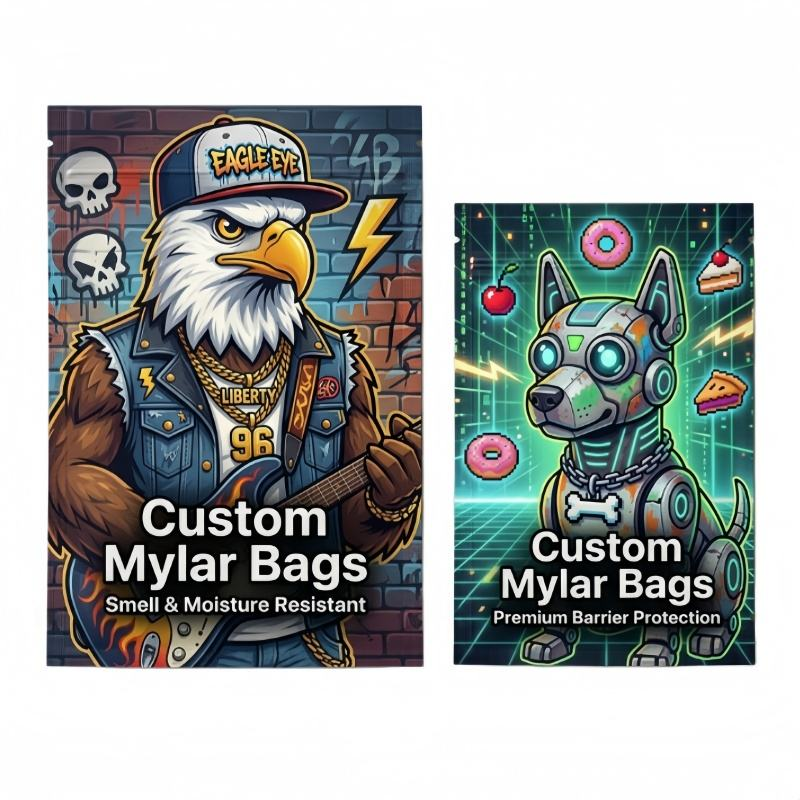
Custom printed 3.5g cannabis mylar bags are matte foil-laminated Mylar bags specified for cannabis brands, private-label programs, distributors, wholesalers, and multi-SKU buyers packaging an approximately 3.5g fill of flower. The matte exterior supports a subdued branded appearance, while the foil-laminated structure can help limit aroma transfer and exposure to light, moisture, and oxygen when the complete laminate and seal system are properly specified and sealed. A stated 3.5g fill weight does not establish one universal pouch size, so actual flower density, desired headspace, closure, and sealing method should be confirmed before production.
Product Specifications
| Product type | Custom printed cannabis Mylar bag |
|---|---|
| Reference fill | 3.5g; final usable volume and dimensions require confirmation |
| Material or structure | Foil-laminated Mylar structure, with the complete layer construction to be confirmed |
| Exterior finish | Matte |
| Odor positioning | Smell-resistant packaging design; actual containment depends on laminate, seals, closure, and handling |
| Printing | Custom printed; artwork method, coverage, and printable area require confirmation |
| Closure | To be selected and confirmed, such as a resealable zipper and/or heat seal |
| Intended application | Branded cannabis flower packaging, subject to fit and destination-market requirements |
How the Matte Foil-Laminated Structure Supports Flower Packaging
Foil-laminated cannabis bags use multiple material layers rather than relying on the matte appearance alone. The foil layer may improve resistance to light and contribute to an aroma and gas barrier, while the polymer sealing layer determines much of the heat-seal behavior. The full structure, seal width, zipper area, and production controls affect whether the finished bag helps contain aroma and protects the contents during storage and distribution.
For cannabis flower, aroma containment is a system decision. A properly sealed bag with a suitable barrier structure can be smell resistant, but “smell-proof” should not be treated as a permanent or absolute performance guarantee without product-specific testing. Moisture and oxygen protection also depend on the complete laminate, closure, seal integrity, and storage conditions. If terpene retention, shelf life, or barrier data is important, request the relevant test method and performance information for the selected structure rather than assuming that every Mylar bag has the same protection.
Fit, Density, Headspace, and Filling Behavior
The 3.5g reference describes the intended fill weight, not a fixed bag dimension. Dense flower and loose flower occupy different volumes, and buds may require additional headspace to avoid compression or excessive movement. Share the actual product dimensions or a representative sample when specifying the bag. The required width, height, gusset, opening position, and seal geometry depend on the product profile and filling equipment.
If the selected format includes a gusset or stand-up construction, the gusset can improve filling stability and presentation, but it also changes usable volume and seal geometry. A flat format may use space differently and may be more suitable for a particular packing line. Confirm whether filling will be manual, semi-automatic, or automated, and test the filled bag for product clearance, zipper engagement, seal contamination, and tear-notch access before approving a production specification.
Closure and Seal Decisions
An ordinary resealable zipper can support repeated opening and closing, but it is not automatically a child-resistant closure. If the destination market requires child-resistant cannabis packaging, specify a tested child-resistant system separately and confirm the applicable requirements before artwork approval. Do not treat a zipper, tear notch, or heat seal as interchangeable functions.
A heat seal can provide a tamper-evident or distribution seal when correctly designed and applied, while a zipper can improve consumer resealability after opening. These features can be combined or configured differently, subject to the selected bag construction and production process. Ask for the recommended sealing temperature, dwell conditions, seal width, and compatibility with the filling line if those details are necessary for your quality process.
Custom Printing, Matte Appearance, and Multi-SKU Control
Custom printed marijuana mylar bags can carry strain names, brand elements, product information, and market-specific artwork. The printable area is controlled by the bag dimensions, seal zones, zipper placement, tear notch, gussets, and die line. Keep critical text and regulatory panels away from areas that may be hidden, folded, or consumed by the heat seal. The matte surface affects the visual result and may change how dark colors, fine text, gradients, and metallic effects appear.
For a multi-SKU program, establish one approved dieline and repeatable specifications across every version. Confirm how strain names, flavor or cultivar details, weights, batch fields, warning panels, and destination-market information will change from SKU to SKU. A shared structure can simplify procurement, but artwork variation still requires version control, proof approval, barcode or variable-data review where applicable, and a clear master specification.
Important Trade-Off: Barrier Versus Product Visibility
The foil-laminated structure prioritizes barrier and privacy over direct product visibility. That can be useful for aroma-sensitive flower and light-sensitive contents, but buyers cannot inspect the flower through an opaque bag. A clear window may improve visual merchandising, yet it can reduce the continuous light barrier and change the laminate specification. If product visibility is required, compare the commercial benefit against the desired light, aroma, moisture, and oxygen protection instead of adding a window without review.
Destination-Market and Quality Confirmation
Packaging requirements vary by destination market and product category. Before issuing final artwork, confirm required warnings, labeling space, child-resistance expectations, tamper-evidence expectations, material declarations, and any food-contact or cannabis-packaging documentation relevant to the sale. These bags are described by their stated product attributes; no certification, approval, laboratory result, or compliance status should be assumed from the material name or “smell-proof” search language.
For quality approval, evaluate an assembled sample using the intended flower density and filling process. Check bag dimensions, usable volume, headspace, zipper function, tear-notch opening, heat-seal appearance, print registration, matte finish, odor containment expectations, and resistance to puncture during handling. If barrier performance is critical, request structure-specific oxygen-transmission, moisture-transmission, or seal-integrity information rather than relying on generic packaging claims.
RFQ Information for Wholesale and Private-Label Orders
To receive a useful quotation for cannabis mylar bag manufacturer wholesale supply, provide the contents, target fill weight, actual product dimensions, desired bag dimensions, quantity, number of artwork versions, artwork files or dieline requirements, foil-laminated material or barrier preference, closure choice, matte finish requirements, filling method, and destination market. Also state whether you need an ordinary resealable zipper, a heat-seal-only format, or a separately specified child-resistant closure. These details allow the bag structure and geometry to be evaluated against the product rather than treated as a generic 3.5g pouch.
Frequently Asked Questions
Are these bags a fixed size for 3.5g of flower?
No. A 3.5g fill weight does not establish one universal bag dimension because flower density, bud size, headspace, closure, and filling method affect the required usable volume. Confirm the product dimensions and desired headspace before finalizing the pouch.
Does the foil-laminated Mylar structure guarantee zero odor?
No. The structure is intended to support smell-resistant packaging, but aroma containment depends on the complete laminate, zipper or heat seal, seal integrity, and handling. “Smell-proof” should not be treated as an absolute performance guarantee without product-specific testing.
Can I use a standard zipper if my market requires child-resistant packaging?
No. A standard resealable zipper is not automatically child resistant. If child-resistant packaging is required, specify a separately tested child-resistant closure and confirm the applicable destination-market requirements.
Can different strains use the same bag specification?
Often, a shared bag structure may support multiple SKUs, but flower density, bud size, artwork panels, variable information, and labeling requirements still need review for each version. Approve one master dieline and control every artwork variation.
What should be included in an RFQ?
Include the contents, fill weight or actual product dimensions, desired pouch dimensions, order quantity, artwork versions, material or barrier preference, closure, finish, filling method, destination market, and specific compliance or documentation needs.
Request a Product-Specific RFQ
Send your contents, 3.5g fill target or actual product dimensions, desired pouch dimensions, quantity, artwork versions, material or barrier requirements, closure preference, matte finish requirements, filling method, destination market, and compliance needs. These inputs can be reviewed together to confirm fit, headspace, seal geometry, printing area, and the appropriate specification for your wholesale, private-label, OEM, ODM, or multi-SKU packaging program.

Reviews
There are no reviews yet.