
Custom Breathable Side-Gusset Bags for Potting Soil and Fertilizer
Custom breathable side-gusset bags are flexible bulk packages intended for potting soil, fertilizer, growing media, soil amendments, and related horticultural products. Their defining features are expandable side gussets and a breathable package configuration. They are relevant to cannabis cultivation brands, garden-product suppliers, distributors, private-label buyers, wholesalers, and multi-SKU purchasers that need package dimensions, venting, material, graphics, and sealing specifications matched to the actual contents.
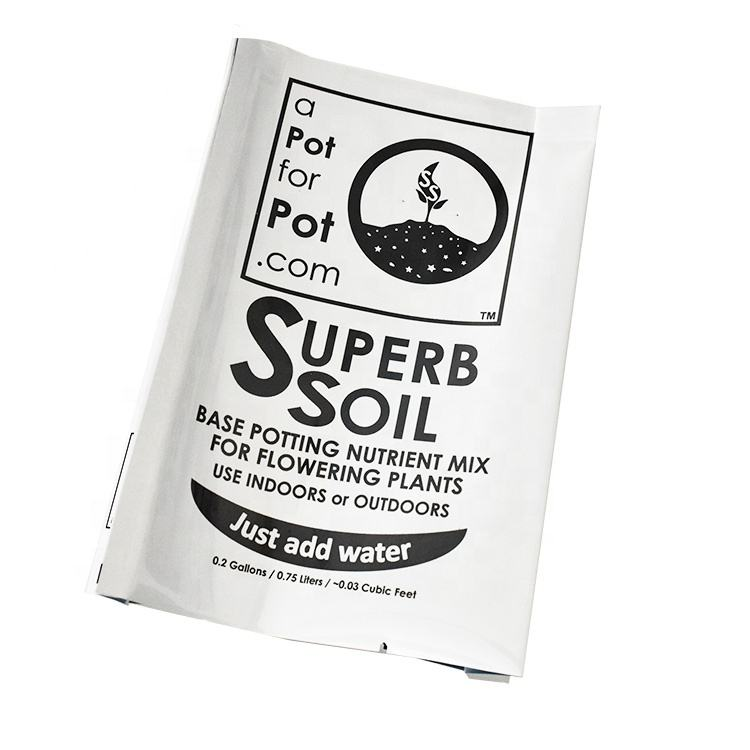
Product Specifications
| Product type | Custom flexible packaging bag |
|---|---|
| Pouch format | Side-gusset bag with expandable side panels |
| Intended contents | Potting soil and fertilizer; suitability for a specific growing medium or amendment must be confirmed |
| Breathability | Breathable configuration; vent type, location, airflow, and particle-retention requirements are subject to specification |
| Material | Flexible substrate or laminate selected according to contents, bag weight, handling, sealing, and barrier requirements |
| Dimensions and capacity | Custom; confirm product density, target fill weight, usable volume, gusset depth, and required headspace |
| Closure | To be specified according to the filling line, distribution conditions, and end-user opening requirements |
| Printing and finish | Custom graphics and finish may be configured subject to artwork, substrate, print process, and production specification |
| Buyer applications | Branded, private-label, OEM, distributor, wholesale, and multi-SKU horticultural packaging programs |
How the Side-Gusset Format Handles Soil and Fertilizer
Side gussets expand as the bag is filled, creating additional internal volume without requiring an unusually wide front panel. This format can accommodate loose, granular, fibrous, or blended contents, but package selection should be based on more than a nominal fill weight. Potting mixes containing bark, perlite, coco fiber, compost, or other components can have substantially different bulk densities. Fertilizer granules and powdered amendments also flow and settle differently.
For accurate sizing, buyers should provide the target fill weight and the volume occupied by a representative production sample. The specification should allow enough headspace for filling, product settling, air displacement, and final sealing. Excess headspace can produce a loose package and inefficient case packing, while insufficient headspace can contaminate the seal area or place unnecessary stress on the top seal.
Breathability, Moisture, and Particle Control
The breathable function can help displaced air escape during filling and palletization. The exact mechanism may involve a breathable substrate, perforation pattern, vent feature, or another engineered configuration, depending on the approved specification. Buyers should identify whether the primary goal is faster air release, reduced package ballooning, product respiration, or pressure equalization.
Breathability creates a product-specific trade-off: increasing airflow may reduce resistance to external moisture, fine-particle escape, odor migration, or contamination. A very fine fertilizer powder requires different vent and particle-retention decisions than coarse bark-based potting soil. Buyers should therefore confirm particle size, dust level, moisture sensitivity, storage environment, and acceptable airflow rather than treating “breathable” as one universal performance level.
Substrate Strength and Seal Performance
The complete material structure determines puncture resistance, stiffness, moisture control, print appearance, and heat sealability. A suitable structure can be configured according to bag weight and distribution stress, but no specific film, woven substrate, paper layer, or laminate should be assumed until selected. Sharp bark, mineral particles, and compressed bag corners may require greater puncture and tear resistance than soft, uniform media.
Material selection should also account for the contents. Fertilizer chemistry, residual moisture, oils, additives, or fine dust may affect compatibility and seal reliability. Product testing with the intended contents is preferable to selecting a substrate by appearance alone. Matte, gloss, kraft-style, metallic, or clear visual effects do not independently establish moisture barrier, oxygen barrier, or mechanical strength.
Filling, Closing, and Distribution Decisions
These side-gusset soil packaging bags should be matched to the buyer’s manual or automated filling process. Relevant details include fill direction, equipment clearances, bag presentation, dust extraction, target line speed, and how the filled package will be closed. Heat sealing may be possible with an appropriate sealable structure; other closing arrangements may be considered depending on the substrate and filling operation. The final closure must be confirmed rather than inferred from the bag shape.
A resealable zipper is not automatically appropriate for heavy soil or fertilizer packs and is not established by the product name. If reclosure is requested, the buyer should state the expected package weight and consumer use pattern. An ordinary zipper must not be represented as a child-resistant closure. Any child-resistant, tamper-evident, or regulated packaging requirement needs a separately defined system and destination-market review.
Custom Printing and Multi-SKU Programs
Custom printed fertilizer bags and potting-soil bags may carry logos, product names, ingredient or composition information, directions, warnings, lot-coding areas, barcodes, and market-specific statements. Available artwork area depends on the bag dimensions, gusset folds, seal geometry, print process, and registration limits. Critical text and scannable codes should remain away from folds, distorted gusset areas, and final seals.
For private-label growing media packaging or multi-SKU programs, a shared structural format can support consistent branding while artwork changes identify soil blends, nutrient formulas, cultivation stages, or distributor labels. Buyers should provide the number of artwork versions and expected quantities by version. Color targets, finish, variable coding, and proofing expectations must be aligned before production. Cannabis cultivation positioning does not remove the need to substantiate environmental, agricultural, safety, or performance claims printed on the package.
Information to Confirm Before Approval
- Contents: potting soil, fertilizer, growing medium, amendment, or blend, including particle size and dust characteristics.
- Pack requirement: target fill weight, measured bulk density, occupied volume, and desired headspace.
- Bag geometry: finished width, length, side-gusset depth, opening orientation, and seal allowances.
- Performance: venting objective, moisture sensitivity, puncture risk, storage conditions, and distribution method.
- Conversion: material preference, closure method, filling equipment, print process, finish, and coding area.
- Commercial program: total quantity, quantity per artwork version, destination market, and applicable labeling or packaging requirements.
Frequently Asked Questions
How is the correct bag size selected for potting soil?
Use the actual volume of the target fill weight, not weight alone. Provide a representative product sample or reliable bulk-density data, then allow appropriate space for filling, settling, gusset expansion, and sealing.
What makes these bags breathable?
The product has a breathable configuration, but the specific venting method must be defined. It may use a selected substrate, perforation pattern, vent feature, or another engineered option suited to the contents and particle-retention requirement.
Can one bag structure be used for both soil and fertilizer?
Possibly, but suitability depends on fertilizer chemistry, moisture sensitivity, particle shape, dust, filled weight, and distribution stress. Each product should be evaluated before one structure is standardized across multiple SKUs.
Can the gussets be custom printed?
Gusset printing may be configured depending on the print process, bag dimensions, fold geometry, and artwork tolerances. Important instructions, small text, and barcodes are generally better positioned in stable, readable areas confirmed on the dieline.
Does a breathable bag protect the contents from moisture?
Breathability and moisture protection can conflict. Actual protection depends on the complete material, vent design, seals, storage environment, and handling, so the required balance must be established during specification and testing.
Request a Product-Specific B2B Quote
To request an RFQ for custom breathable side-gusset bags, provide the contents, target fill weight, measured product volume or bulk density, preferred bag dimensions, side-gusset depth, quantity, number of artwork versions, venting objective, material or barrier needs, closure method, finish, filling process, destination market, and applicable compliance or labeling requirements. These inputs allow a supplier or wholesale soil bag manufacturer to assess structure, sizing, printing, and conversion requirements without relying on unsupported capacity assumptions.


Reviews
There are no reviews yet.