
Custom Printed Child-Resistant Holographic Mylar Bags for Cannabis Packaging
Custom printed child-resistant holographic Mylar bags are flexible cannabis packaging intended for brands, distributors, wholesalers, private-label programs, OEM/ODM buyers, and multi-SKU purchasing teams. The product combines a holographic appearance, custom printing, a stated child-resistant format, and a 3.5–7oz product range. Before an RFQ, confirm the actual pouch dimensions, usable volume, material structure, closure construction, artwork requirements, and destination-market packaging obligations.
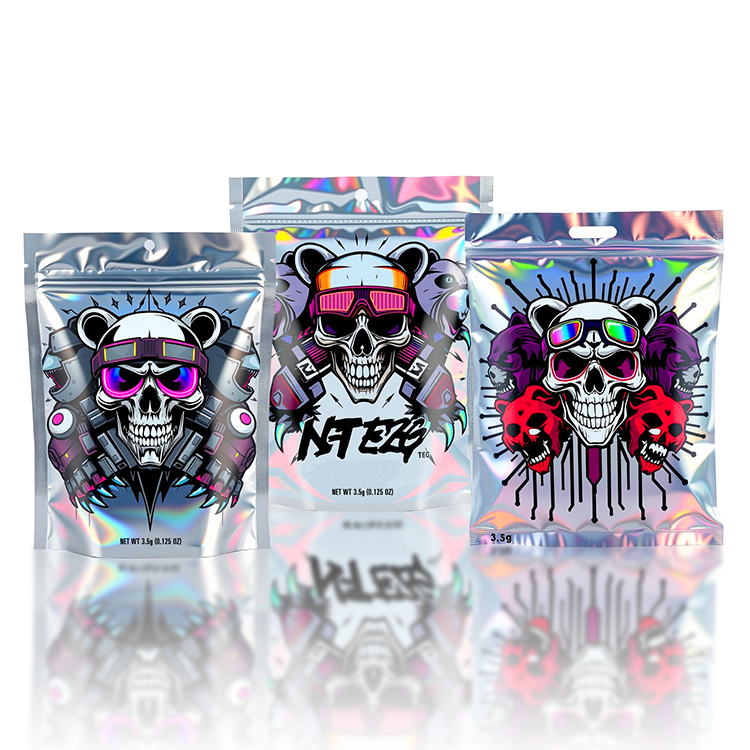
Product Specifications
| Product type | Custom printed child-resistant holographic Mylar bags |
|---|---|
| Stated fill range | 3.5–7oz; confirm the product’s actual density, dimensions, and required usable volume |
| Primary material description | Mylar bag format with holographic appearance; confirm the complete laminate structure |
| Closure | Child-resistant format stated; confirm the specific closure design and any available validation documentation |
| Printing | Custom printing; confirm artwork versions, print colors, print area, and file requirements |
| Intended application | Cannabis product packaging; confirm the contents and destination-market requirements |
| Order planning | Suitable for brand, wholesale, private-label, OEM/ODM, and multi-SKU discussions; confirm quantity and commercial terms |
Choose the Structure Around the Contents
A 3.5–7oz label does not establish one universal pouch size. Cannabis flower can vary substantially in density, particle size, moisture condition, and bulk volume, so two products with the same stated weight may need different bag dimensions and headspace. Send the actual fill weight, product dimensions, density information if available, and preferred headspace when requesting a quotation. A filling trial or physical sample can help confirm whether the opening, usable volume, and seal area work with the filling process.
The holographic appearance describes the visual effect, not the complete barrier construction. Depending on the selected laminate structure, the bag may be configured to help protect contents from light and to help contain aroma, moisture, or oxygen. Barrier performance depends on the full film combination, seal geometry, and sealing process. It should not be inferred from the holographic surface alone. Ask the supplier to identify the proposed layers and to provide applicable technical information for the intended contents and market.
Child-Resistant Closure and Sealing Decisions
The product is described as child-resistant, but an ordinary resealable zipper should not automatically be treated as a tested child-resistant closure. Confirm how the stated child-resistant function is achieved, whether the closure is integrated into the bag, and what validation or market-specific documentation is available. This confirmation is especially important when the packaging will be used for regulated cannabis products.
Ask whether the selected format includes a zipper, heat-seal area, tear notch, or a combination of these features. A zipper can support repeated opening and closing, while a heat seal can provide a separate tamper-evident or initial-seal step when included in the final specification. A tear notch may improve opening convenience but changes how the package is opened. These features should be reviewed together rather than selected independently.
Holographic Appearance, Printing, and Artwork Control
Custom printing lets a cannabis brand coordinate packaging across strains, product variants, and private-label programs. For a holographic bag, confirm how the visual effect interacts with artwork, fine text, barcodes, warning panels, transparent elements, and solid ink coverage. The substrate and finish can affect color appearance, contrast, scannability, and the available print area.
Provide the supplier with the number of artwork versions, required languages, regulatory copy, variable information, and preferred finish. If the bag design uses a window, metallic effect, or high-contrast panel, confirm its location against the dieline and seal area. A holographic appearance can strengthen shelf differentiation, but it may require careful artwork planning where legibility and compliance information must remain clear.
Managing Multiple SKUs and Wholesale Programs
For multi-SKU purchasing, define which specifications must remain identical across every version: bag dimensions, laminate, closure, seal area, holographic effect, print coverage, and opening position. Keeping these elements consistent can simplify filling equipment, carton planning, and quality checks, while separate artwork versions identify strains or product variants.
Private-label and OEM/ODM buyers should distinguish cosmetic changes from construction changes. A new logo or flavor panel may only require artwork approval, whereas a different fill weight, product density, barrier target, or closure may require a new dimensional and packaging review. Confirm whether all artwork versions will be produced under one approved specification and how revisions will be controlled before production.
Destination-Market and Compliance Review
Packaging rules differ by destination market and by cannabis product category. Confirm the required warning statements, symbols, language, child-resistant expectations, tamper-evidence requirements, product-contact conditions, label area, and barcode placement with the responsible compliance team. The presence of a holographic finish or the description “child-resistant” does not by itself establish approval or compliance in a particular jurisdiction.
For cannabis flower, also review aroma containment, moisture management, light exposure, and resealability against the product’s shelf-life and handling requirements. If the bag will hold another cannabis format, such as edibles or concentrates, provide the contents and any grease, moisture, or product-contact considerations before the material structure is finalized.
What to Include in an RFQ
To receive a useful quotation and specification recommendation, provide the intended contents, fill weight, actual product dimensions, desired bag dimensions, quantity, number of artwork versions, material or barrier preference, closure requirement, holographic or other finish preference, filling method, destination market, and compliance needs. Also identify whether you need samples, color approval, barcode placement, or consistency across a multi-SKU range. The supplier can then confirm which details are standard, configurable, or subject to final technical review.
Frequently Asked Questions
Are these bags suitable for a 3.5–7oz cannabis fill?
They are presented for a 3.5–7oz range, but the stated weight does not determine one universal bag size. Confirm the contents, density, actual dimensions, usable volume, and desired headspace before approving the pouch.
Does the holographic finish prove the bag has a specific barrier level?
No. Holographic appearance does not identify the complete laminate or establish oxygen, moisture, aroma, or light-barrier performance. Confirm the proposed structure and applicable technical information for the intended use.
Is the child-resistant closure the same as a standard zipper?
Not necessarily. The product is described as child-resistant, while an ordinary zipper should not automatically be treated as a tested child-resistant closure. Confirm the closure design and available validation documentation.
Can one bag specification support multiple cannabis strains?
Potentially, if the fill weights, product density, dimensions, closure, barrier needs, and filling method are compatible. Confirm the shared construction and manage each strain or product variant through separate approved artwork.
What should a private-label buyer send for pricing?
Send the contents, fill weight or actual product dimensions, desired pouch dimensions, quantity, artwork versions, material or barrier preference, closure, finish, filling method, destination market, and compliance requirements.
Request an RFQ for your cannabis packaging program. Include the contents, fill weight or actual product dimensions, desired bag dimensions, quantity, artwork versions, material or barrier requirements, closure, finish, filling method, destination market, and compliance needs so the specification can be reviewed accurately.

Reviews
There are no reviews yet.