
Custom Printed 3.5g Stand-Up Mylar Pouches for Cannabis Brands
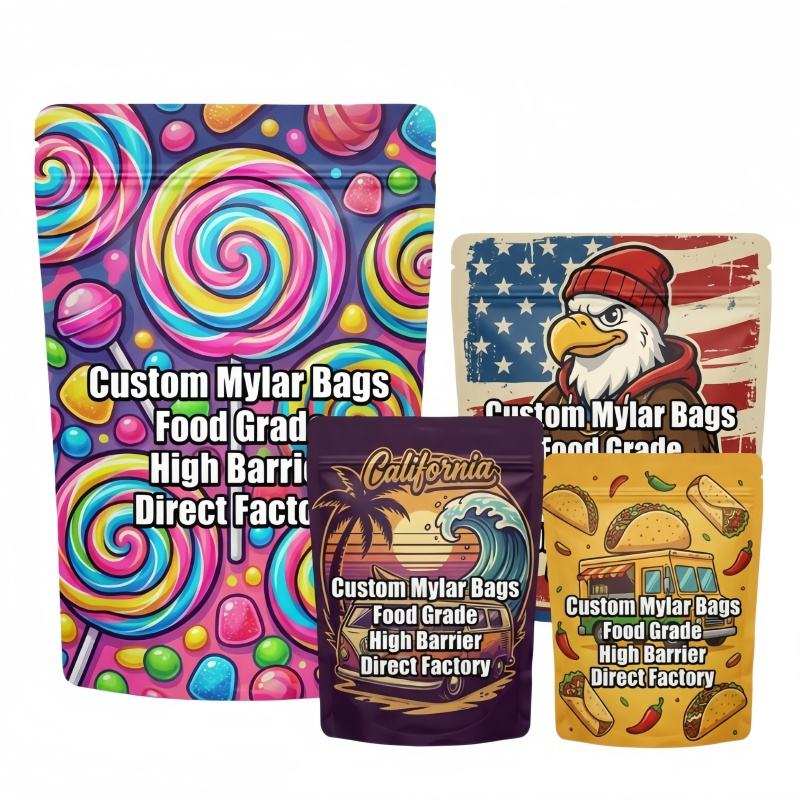
Custom printed 3.5g stand-up Mylar pouches are thick, upright flexible bags intended for portioned cannabis products, subject to confirmation of the final product, dimensions, and packaging specification. Their stand-up format supports shelf presentation and filling, while custom printing gives cannabis brands, distributors, private-label buyers, and multi-SKU programs space for strain or product-specific artwork. A stated 3.5g fill weight does not establish one universal pouch size because flower density, product dimensions, headspace, and closure geometry affect the required format.
Product Specifications
| Product type | Stand-up flexible pouch |
|---|---|
| Product name | Custom printed 3.5g thick stand-up Mylar pouches |
| Reference fill weight | 3.5g; confirm whether this refers to cannabis flower or another product |
| Material | Mylar pouch structure; confirm the complete laminate and barrier layers |
| Printing | Custom printed; confirm artwork, colors, print area, and substrate limitations |
| Format | Stand-up design with a bottom gusset; confirm finished dimensions and usable volume |
| Closure | Confirm zipper, heat-seal configuration, tear notch, and any child-resistant requirement |
| Finish | Confirm matte, gloss, metallic, kraft-look, or other selected appearance |
| Commercial scope | Suitable for B2B quotation review; confirm quantity, SKU count, and destination market |
Fit the Pouch to the Actual Product
For cannabis flower, the practical question is not only whether a pouch is labeled 3.5g. Flower density varies by strain, trim, moisture condition, and particle structure, so two products with the same mass may require different usable volumes. Ask for the product’s actual dimensions or a representative sample, then confirm the pouch width, height, bottom gusset, opening, and recommended headspace. Excess headspace can allow more movement and affect presentation; insufficient headspace can make filling, sealing, and final inspection difficult.
The stand-up construction can help a filled pouch remain upright during handling and display. The gusset also creates a base for automated or manual filling, but the filling method should be considered before finalizing dimensions. A pouch sized for a hand-fill process may not behave the same way on a dispensing or packing line. Confirm the equipment opening, product drop height, sealing area, and whether the pouch must remain stable before the top seal is applied.
Material, Barrier, and Seal Decisions
“Mylar” identifies the requested pouch category, but appearance alone does not define the complete barrier structure. The laminate selected for the finished bag influences stiffness, puncture resistance, aroma retention, moisture control, oxygen exposure, light protection, and heat-seal behavior. A thicker structure may provide a firmer feel and greater resistance to handling damage, but it can also affect folding, sealing conditions, cost, and production compatibility. Confirm the complete laminate, layer thicknesses, sealant layer, and any available barrier data during the RFQ process.
For aromatic cannabis products, a suitable laminate and properly formed seals can help contain aroma. This should not be treated as a permanent or absolute smell-proof guarantee without product-specific testing. Moisture and oxygen requirements also depend on the contents, intended shelf life, storage conditions, and destination-market expectations. If light-sensitive contents are being packed, confirm whether the selected structure is opaque or includes any visibility feature. A metallic or decorative appearance does not, by itself, prove a particular barrier performance.
Heat sealing can create a stronger tamper-evident or transport-ready closure, while a resealable zipper supports repeated access. These functions are different. An ordinary zipper should not be described as a tested child-resistant closure. If child-resistant packaging is required, identify the destination market and request the appropriate closure specification and evidence before approving artwork or production.
Custom Printing for Strains and Multi-SKU Programs
Custom printing makes this format useful for branded cannabis flower lines, private-label programs, and distributors managing several strains or product variants. Before artwork approval, confirm the printable panel, gusset visibility, seal exclusion zones, tear-notch position, opening orientation, and any registration or color limitations created by the selected substrate. Important warnings, variable data, batch information, or regulatory text may need a clearly defined area that remains readable after filling.
For a multi-SKU order, establish whether every strain uses the same pouch dimensions and structure or whether selected products require different volumes. A consistent outer format can simplify cartons, shelving, and operational handling, but forcing all products into one size may create excess headspace for some SKUs or filling pressure for others. Separate artwork versions should be listed clearly, with approved files, version control, variable information, and a defined process for checking print proofs.
Closure and Opening Configuration
Confirm whether the required package uses a resealable zipper, a heat seal above the zipper, a tear notch, or a combination. A zipper supports repeated opening, while a top heat seal may provide an additional sealed barrier until the customer opens it. The opening position should leave enough clearance for fingers without reducing the artwork or warning area. Tear-notch placement also affects how cleanly the pouch opens and whether the remaining package can still be resealed.
Closure choices involve a trade-off: more closure functions may improve usability, but they can change the top-seal geometry, filling workflow, pouch cost, and available print area. The final decision should reflect the product, handling process, legal requirements, and intended consumer use rather than the appearance of the sample alone.
Destination-Market and Compliance Review
Cannabis packaging rules differ by destination and may address child resistance, tamper evidence, opacity, labeling, warnings, symbols, net contents, lot identification, or contact-material requirements. This pouch should therefore be reviewed against the specific market and product category before an order is released. Do not assume that a custom printed cannabis bag is automatically compliant, child resistant, food-contact suitable, or approved for every jurisdiction. Confirm which party is responsible for artwork review, testing, declarations, and final regulatory sign-off.
Questions Buyers Should Confirm Before an RFQ
Is 3.5g a guaranteed pouch capacity?
No. The stated 3.5g reference does not establish one universal capacity. Confirm the actual contents, density, product dimensions, desired headspace, and finished pouch measurements.
Are these pouches suitable for cannabis flower?
They can be evaluated for portioned cannabis flower, subject to the product’s volume, aroma, moisture, light, closure, and destination-market requirements. The final laminate and seal specification should be confirmed before approval.
Does thick Mylar mean the pouch is completely smell proof?
No absolute performance claim should be assumed. Aroma containment depends on the complete laminate, seal geometry, closure, and sealing process; a suitable specification may help contain aroma when properly sealed.
Can one pouch format support multiple strains?
Possibly, if the strains have comparable density and volume. Confirm each SKU separately because equal fill weights can occupy different volumes and require different headspace.
Can a zipper be treated as child resistant?
No. An ordinary resealable zipper is not the same as a tested child-resistant closure. Identify any child-resistant requirement by destination market and request the relevant specification or evidence.
Request a B2B Pouch Specification
For a useful quotation, send the contents, 3.5g fill target or actual product dimensions, desired pouch dimensions, quantity, number of artwork versions, material or barrier preference, closure configuration, finish, filling method, destination market, and applicable compliance needs. If possible, include a product sample or dimensional drawing. These details allow the pouch structure, gusset, headspace, print area, and seal arrangement to be evaluated against the actual program rather than estimated from fill weight alone.
Reviews
There are no reviews yet.