
Custom holographic 3.5g Mylar bags for branded cannabis packaging
These custom holographic 3.5g Mylar bags are flexible packaging bags with a holographic appearance and custom logo printing for cannabis brands, private-label programs, distributors, wholesalers, and multi-SKU product lines. The stated 3.5g format identifies the intended fill-weight category, but it does not establish one universal pouch dimension because flower density, product shape, headspace, closure design, and filling equipment affect the required usable volume.
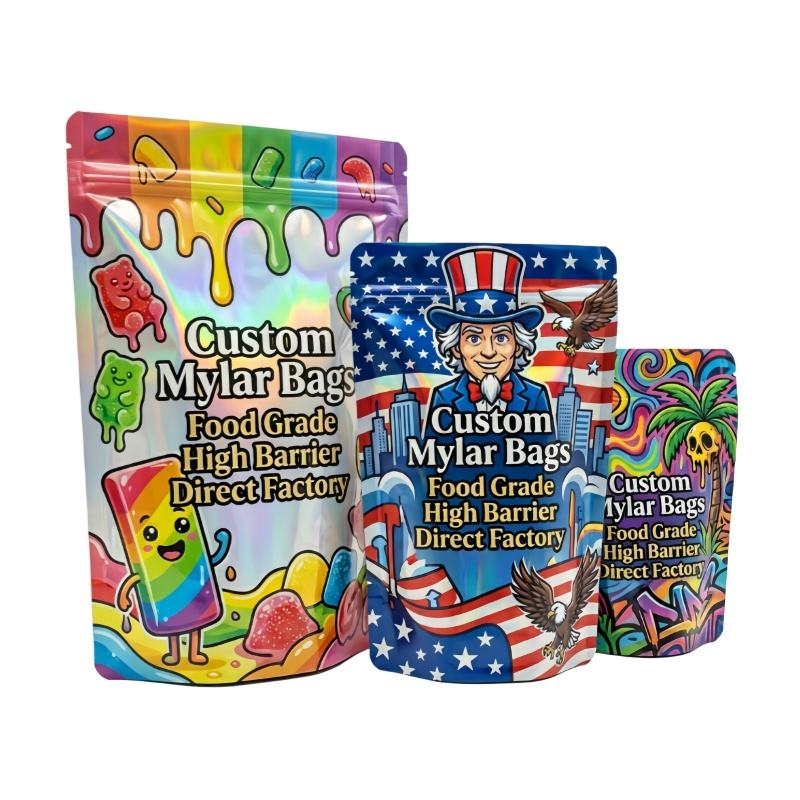
Product Specifications
| Product type | Custom flexible cannabis packaging bag |
|---|---|
| Intended format | 3.5g fill-weight category; final size requires product and packing confirmation |
| Material | Mylar-style flexible packaging; exact laminate structure is subject to final specification |
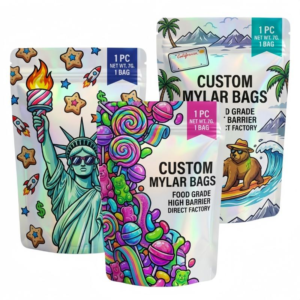
| Appearance | Holographic finish or holographic visual effect |
| Printing | Custom logo printing |
| Closure | Closure type, zipper, heat-seal configuration, and tear feature require confirmation |
| Barrier performance | Depends on the complete laminate, seal geometry, and sealing process |
| Typical buyer | Cannabis brands, wholesalers, distributors, private-label, OEM, ODM, and multi-SKU purchasers |
How the 3.5g format affects pouch selection
A nominal 3.5g flower fill can occupy different volumes depending on density, trim, moisture condition, particle size, and how much headspace is preferred. A pouch that is too tight can compress flower and make filling or sealing inconsistent. A pouch that is too large can allow excess movement and create a less controlled presentation. Buyers should confirm the actual product dimensions, target headspace, fill method, and desired finished pouch dimensions before approving a sample or quotation.
For cannabis flower, headspace can influence aroma management, product movement, and the visual presentation of the pack. These bags may help contain aroma when the selected laminate and closure system are appropriate and the package is properly sealed. No holographic appearance by itself proves a specific odor, moisture, oxygen, or light barrier. The complete structure and seal process must be evaluated for the destination market and product requirements.
Material structure and barrier decisions
“Mylar” is commonly used in packaging searches to describe a polyester-based flexible film or a bag made with a related laminate. The exact layers in this product are not specified in the supplied information, so buyers should request the proposed structure for review. Depending on the selected laminate, layers may be configured to balance light protection, aroma containment, moisture resistance, oxygen resistance, puncture resistance, stiffness, printability, and heat sealability.
These properties involve trade-offs. A more protective opaque structure can reduce light exposure, but it may provide less product visibility than a clear window. A stiffer or heavier structure may improve handling and shelf presentation, while a highly flexible structure may be easier to pack and ship. The holographic effect also needs to be coordinated with the printable surface and artwork so that the logo remains legible rather than competing with the reflective pattern.
Pouch style, opening, and sealing
The final bag style should be matched to the filling operation. A flat pouch, gusseted pouch, or another configured shape can behave differently during filling, standing, stacking, and heat sealing. Confirm the seal width, opening position, gusset dimensions if applicable, and the area reserved for the product and closure. These details help prevent artwork from entering the seal zone and help the filling team achieve repeatable production.
An ordinary resealable zipper can support repeated opening and closing, but it should not be described as a tested child-resistant closure unless the relevant design and testing have been specifically confirmed. A tear notch may improve opening convenience, while a heat seal can provide a tamper-evident-style sealed presentation when correctly specified and applied. Zipper, tear notch, heat seal, and any child-resistant feature should therefore be listed separately in the RFQ rather than treated as interchangeable options.
Logo printing and holographic artwork control
Custom logo printing makes the bag suitable for branded cannabis collections, strain families, private-label programs, and wholesale packaging. Before production, provide vector artwork where available and identify the logo position, color requirements, required text, warning-panel space, barcode area, and any variable information for different SKUs. The printable area should be checked against the die line, opening, zipper, tear notch, gusset, and heat-seal zones.
Holographic effects can add shelf impact, but they may affect contrast, small text, barcode readability, and color perception under different lighting. Ask for an artwork proof or sample showing the logo over the intended holographic treatment. If multiple strain or flavor versions are planned, confirm whether the same structure and dimensions will be used across all SKUs and which elements will change between versions.
Multi-SKU and private-label procurement
For OEM, ODM, private-label, and wholesale programs, consistency matters beyond the first printed bag. Define the common elements, variable artwork, version-control process, acceptable color tolerance, and approval procedure for each SKU. A shared bag specification can simplify filling and purchasing, while separate artwork versions can distinguish strains or product lines. If the contents differ in density or physical dimensions, one nominal 3.5g format may not perform identically across every SKU.
Buyers should also separate packaging appearance from regulatory suitability. Required warnings, symbols, child-resistant expectations, language, recycling marks, barcode placement, and other labeling elements vary by destination market and product category. Confirm the applicable requirements with the responsible compliance team or local adviser. The selected bag, laminate, ink system, closure, and final printed content should be reviewed against those requirements before approval.
What to confirm before requesting a quotation
- State the actual contents, target fill weight, product dimensions, density, and preferred headspace.
- Provide desired finished pouch dimensions, pouch style, opening position, and filling method.
- Specify the required laminate or ask for structure options based on aroma, moisture, oxygen, light, and puncture priorities.
- Choose the closure arrangement, including zipper, heat seal, tear notch, or a separately verified child-resistant design.
- Send logo artwork, the number of artwork versions, print colors, holographic treatment, finish, barcode area, and required regulatory text.
- Identify quantity by SKU, destination market, compliance needs, and any sample or approval-stage requirements.
Frequently asked questions
Are these bags a fixed universal size for 3.5g of flower?
No. The product is identified for a 3.5g fill-weight format, but flower density, headspace, pouch style, and filling method determine the suitable dimensions. Confirm the actual product and desired finished size before ordering.
Does the holographic finish establish the bag’s barrier performance?
No. A holographic appearance does not by itself define the laminate or guarantee odor, moisture, oxygen, or light protection. Barrier performance depends on the complete structure and the sealing system.
Can the logo be printed on the holographic surface?
Custom logo printing is part of the stated product concept, but the final printable area, contrast, colors, and artwork treatment should be confirmed with the proposed substrate and holographic effect.
Can I specify a zipper or child-resistant closure?
Closure options require confirmation. An ordinary resealable zipper should not be treated as child-resistant unless a suitable design and applicable testing have been specifically documented for the selected package.
Can one bag specification support several cannabis SKUs?
It may be possible when the products have compatible physical dimensions and the same packaging requirements. Different densities, artwork versions, warning panels, or destination-market rules may require separate specifications or approvals.
Request a B2B packaging quotation
To request an accurate RFQ for these custom holographic 3.5g Mylar bags, provide the contents, fill weight, actual product dimensions, desired pouch dimensions, quantity by SKU, artwork versions, preferred material or barrier priorities, closure, finish, filling method, destination market, and compliance needs. This information allows the packaging specification, artwork area, sealing arrangement, and sample requirements to be reviewed before commercial confirmation.
Reviews
There are no reviews yet.