
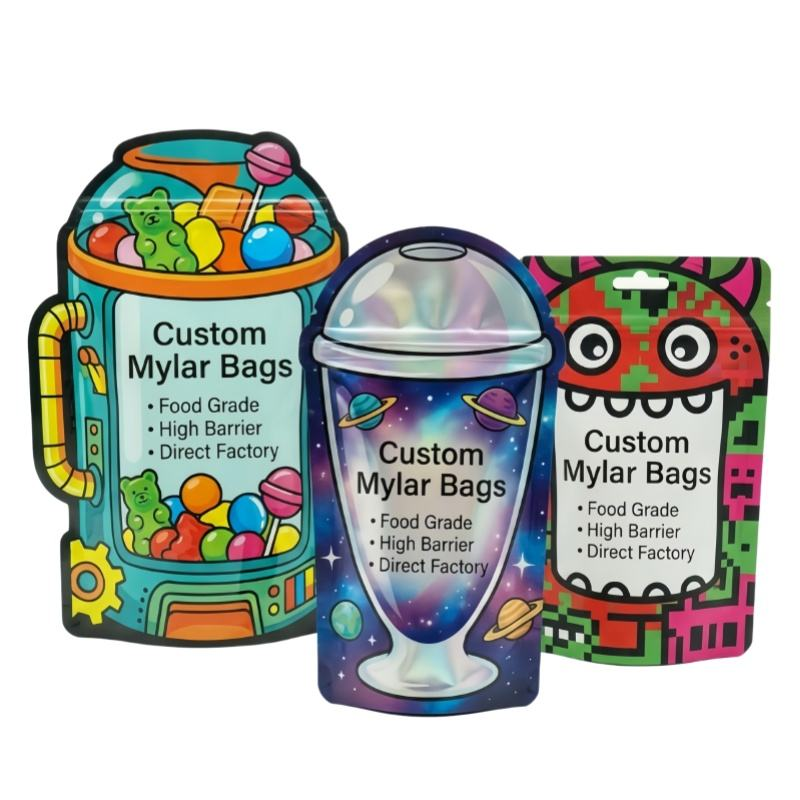
7g Holographic Child-Resistant Gummy Pouches for Custom Print Programs
These 7g holographic child-resistant gummy pouches are custom printed Mylar flexible packages intended for cannabis gummies and other regulated edible products. Their defining specifications are a 7g stated fill weight, holographic appearance, custom graphics, and a child-resistant format. They are relevant to cannabis brands, edible manufacturers, distributors, wholesalers, private-label programs, importers, and buyers managing several artwork versions. Final pouch dimensions, laminate construction, closure mechanism, and market-specific compliance evidence must be confirmed before production.
Product Specifications
| Specification | Current Product Detail |
|---|---|
| Product type | Custom printed flexible gummy pouch |
| Intended contents | Cannabis gummies or comparable edible products |
| Stated fill weight | 7g; final fit depends on gummy count, shape, density, and headspace |
| Material description | Mylar pouch; exact laminate layers and thickness require confirmation |
| Appearance | Holographic |
| Printing | Custom printed; process, ink system, white layers, and artwork limits require confirmation |
| Child-resistant feature | Specified as child-resistant; closure design, testing evidence, and destination-market suitability require confirmation |
| Pouch dimensions and style | Not stated; confirm width, height, gusset or flat format, and usable fill area |
| Final sealing method | Confirm according to the selected pouch construction and filling process |
Mylar Laminate, Barrier, and Holographic Appearance
In flexible-packaging RFQs, Mylar commonly refers to a polyester-based film or laminate, but the term alone does not identify every layer. The complete structure determines stiffness, puncture resistance, heat sealability, and resistance to moisture, oxygen, aroma migration, and light. Buyers should request the proposed layer sequence and thickness rather than treating all holographic Mylar edible bags as technically identical.
A suitable laminate can help contain gummy aroma and limit environmental exposure when the pouch is properly sealed. Actual barrier performance depends on the films, adhesives, ink coverage, closure, edge seals, and production sealing conditions. The holographic visual effect does not by itself prove that the package is smell proof, opaque, food-contact suitable, or appropriate for a particular shelf-life target.
Determining the Correct Pouch Size for a 7g Fill
A 7g label does not establish one universal pouch dimension. Seven grams of small, dense gummies can occupy less space than seven grams of aerated, sugar-coated, irregular, or individually wrapped pieces. The buyer should evaluate gummy dimensions, piece count, coating, bulk density, and the amount of headspace needed for filling and closure operation.
Confirm whether the package is flat, bottom-gusseted, or another format. A gusset may improve usable volume and shelf presentation, while a flat pouch may suit a compact pack but provide less internal depth. Excess space can allow product movement and make a small portion look undersized; insufficient headspace can place gummies in the zipper or heat-seal area and interfere with reliable sealing.
Child-Resistant Closure and Final Heat Seal
This product is identified as child-resistant cannabis gummy packaging, but procurement teams should still confirm how the child-resistant function is achieved. An ordinary press-to-close zipper is not automatically a tested child-resistant closure. The mechanism may require a specialized zipper, concealed opening sequence, or another construction, subject to the final specification.
Ask the supplier for documentation applicable to the exact pouch and closure configuration being quoted. Suitability can depend on pouch dimensions, film structure, closure placement, and the rules of the destination market. A tamper-evident top heat seal may be specified above the reclosable feature, but tamper evidence and child resistance are separate functions. Tear notches must also be positioned so they do not defeat the intended opening system.
Custom Printing and Multi-SKU Artwork
Custom printed 7g gummy pouches can carry brand graphics, flavor identification, potency information, warnings, ingredients, serving details, batch information, and other required copy, subject to the approved die line and local rules. The printing method, number of colors, variable elements, color targets, and surface finish should be established during artwork review.
Holographic film creates a product-specific design trade-off. Leaving selected areas uncovered can maximize the reflective effect, while white ink backing can improve color opacity and text contrast but reduce holographic visibility in those areas. Fine type, barcodes, warning panels, and pale colors may need controlled white layers and sufficient quiet space for readability.
For private-label multi-SKU edible pouches, use one approved structural die line and a documented artwork hierarchy across flavors or product variants. Confirm how many designs are included, which elements change, and whether color references must remain consistent between production runs.
Filling, Sealing, and Gummy Compatibility
Gummies may carry sugar, acid, oil, or other surface ingredients. Depending on the formulation, the selected food-contact layer may need appropriate resistance to grease, moisture, and flavor interaction. Product compatibility and shelf-life suitability should be evaluated for the actual gummy rather than inferred from the pouch appearance.
Manual and automated filling operations can require different pouch opening behavior, stiffness, zipper clearance, and seal-area cleanliness. Product particles or coatings in the seal zone can weaken the final heat seal. Confirm the filling method, intended sealing equipment, and recommended sealing parameters with the selected packaging specification.
Destination-Market and Label Review
Cannabis edible packaging rules can differ by country, state, province, and sales channel. Requirements may address child resistance, tamper evidence, opacity, resealability, universal symbols, warnings, serving information, and food-contact materials. A wholesale cannabis pouch supplier can provide specification documents, but the buyer remains responsible for confirming that the finished package and artwork meet the requirements of the intended market.
Frequently Asked Questions
Does a 7g fill weight determine the pouch dimensions?
No. Final dimensions depend on gummy size, shape, piece count, density, coating, desired headspace, pouch style, and filling method. A physical fill test is preferable before approving the production die line.
Is every resealable zipper child-resistant?
No. A conventional resealable zipper is not automatically child-resistant. Confirm the exact opening mechanism and request applicable evidence for the finished pouch configuration and destination market.
Does holographic Mylar make the pouch smell proof?
No absolute odor claim can be made from appearance or the word Mylar alone. Aroma containment depends on the complete laminate, closure, seals, contents, storage conditions, and whether the package is properly sealed.
Can different gummy flavors use coordinated custom artwork?
Yes, artwork can be planned as a coordinated multi-SKU system, subject to the chosen printing process and production specification. Confirm the number of versions, shared design elements, variable copy, color standards, and die-line consistency.
What should be provided for an accurate RFQ?
Provide the gummy type, 7g portion details, piece count and dimensions, preferred pouch dimensions or samples, order quantity, artwork versions, barrier needs, child-resistant closure requirement, finish, filling method, destination market, and applicable compliance needs.
Request a Product-Specific B2B Quotation
For a comparable quotation, submit the actual gummy format, target 7g pack configuration, desired pouch style and dimensions, quantity, number of artwork versions, holographic coverage, preferred barrier structure, child-resistant opening requirement, final heat-seal method, filling process, and destination market. These inputs allow the supplier to evaluate usable volume, print execution, closure placement, laminate selection, and documentation requirements without relying on unsupported assumptions.
Reviews
There are no reviews yet.