
3.5g–1lb stand-up Mylar bags for flexible product packaging
3.5g–1lb stand-up Mylar bags are food-grade stand-up pouches intended for buyers who need a flexible format across several fill-weight programs. The stated range supports procurement planning for cannabis brands, distributors, wholesalers, private-label and OEM buyers, importers, and multi-SKU teams. The pouch format is designed to stand upright, while the final usable volume, dimensions, headspace, barrier structure, closure, and print specification must be confirmed against the actual product.
Product Specifications
| Product | Food-grade stand-up Mylar bags |
|---|---|
| Stated fill-weight range | 3.5g to 1lb |
| Pouch style | Stand-up pouch |
| Material | Mylar; the complete laminate or film structure requires confirmation |
| Intended procurement use | Flexible packaging evaluation for cannabis, food, and other suitable packaged products |
| Closure and seal | To be confirmed for the selected configuration; zipper and heat-seal options may be available depending on specification |
| Printing and finish | To be confirmed, including artwork coverage, colors, substrate limits, and surface finish |
| Dimensions | Not stated; confirm finished width, height, bottom gusset, seal area, and opening position |
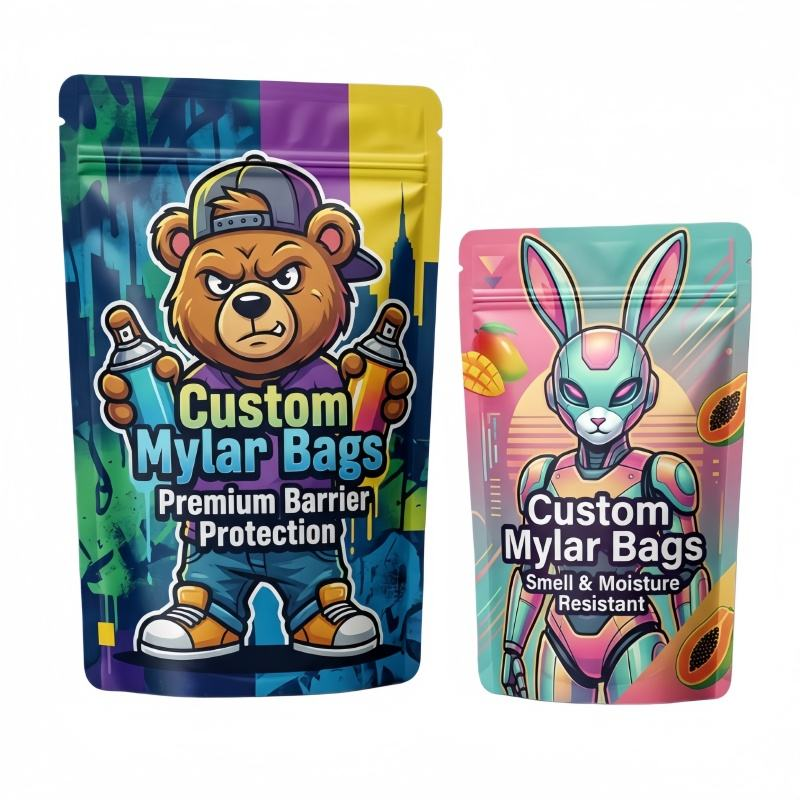
Match the pouch to the actual product
A 3.5g fill and a 1lb fill should not be treated as interchangeable packaging specifications. Product density, particle size, moisture content, settling behavior, and the amount of headspace needed above the contents all affect the practical pouch size. A nominal fill weight does not establish one universal bag dimension. For cannabis flower, buyers should confirm the packed product’s bulk density, expected expansion, aroma sensitivity, and whether the pouch will be filled manually or by equipment. For food or other products, confirm whether the contents are dry, oily, sharp-edged, fragile, or sensitive to moisture and oxygen.
The stand-up construction can support shelf presentation and upright filling, but the bottom gusset must be sized and sealed for the intended load. A wider gusset may improve stability and usable volume, while additional gusset material can affect material consumption, shelf footprint, and the amount of artwork available near the lower seal. Request a drawing or pre-production sample before approving a multi-SKU rollout.
Mylar structure, barrier, and product protection
Mylar describes the requested packaging material, but appearance alone does not define the complete barrier system. Depending on the selected laminate structure, the pouch may be configured to help limit moisture transfer, oxygen exposure, light transmission, puncture risk, and aroma release. Those functions depend on the complete film combination, thickness, seal quality, closure, and filling process—not simply on a metallic, matte, or colored appearance.
For aroma-sensitive cannabis products, an odor-resistant cannabis stand-up bag should be evaluated as a system. A properly sealed pouch with a suitable barrier structure may help contain aroma, but no permanent or absolute smell-proof performance should be assumed without a defined test method and agreed specification. A metallic or opaque structure may provide stronger light protection than a clear window, but reduced product visibility is the trade-off. A window can help inspection and merchandising while allowing more light through, depending on its size and construction.
Food-grade designation identifies the stated product positioning, not a destination-market approval or a specific food-contact certificate. Buyers should request the applicable declaration, test documentation, or compliance records needed for the product and market before production. Confirm the complete laminate, intended contents, temperature exposure, seal conditions, and any local packaging requirements.
Closure, opening, and seal decisions
A resealable zipper can support repeated opening and closing, which may be useful for flower, dry goods, or other products that are not consumed in one opening. It is not the same as a tested child-resistant closure. If child-resistant packaging is required, specify that requirement separately and request the applicable test evidence for the final pouch configuration. A zipper also does not replace the need for a reliable heat seal when tamper evidence, initial protection, or longer-term barrier performance is part of the specification.
A tear notch can make the first opening easier, but its position must work with the zipper, top seal, artwork, and filling line. Buyers should confirm whether the product will be hand-filled or machine-filled, how the pouch will be opened after filling, and whether the top seal needs a defined width. Seal contamination from powder, oil, or product particles can affect closure quality, so the selected material and process should be tested using the actual contents.
Custom printing and brand-family consistency
Custom printed Mylar bags for cannabis can consolidate multiple strains, flavors, sizes, or private-label variants into one visual system. Before artwork begins, confirm the usable print area, front and back panels, gusset visibility, seal exclusions, zipper position, tear-notch location, barcode placement, and any required warning or information panels. The selected surface finish—such as matte, gloss, metallic, or another appearance—may affect color reproduction, scuff visibility, opacity, and the way the underlying substrate presents on shelf.
For multi-SKU procurement, define which elements remain constant and which change by SKU. A controlled template can preserve logo placement, regulatory space, net contents, batch fields, and barcode zones while allowing strain or flavor identification to vary. Ask for a digital proof and, where color accuracy is important, a physical approval sample. Printing capability, minimum repeat length, spot-color handling, and substrate limitations should be confirmed rather than assumed.
Specification trade-offs for B2B buyers
The principal trade-off is between presentation, protection, and operational simplicity. A highly opaque barrier structure may improve light protection and support aroma control, but it can hide the product and may require a more specific print treatment. A visible window improves inspection but can reduce light protection in that area. A zipper improves resealability but adds a closure component that must align with the filling process and may change the usable headspace. Larger bags can accommodate product variation, yet excess headspace may increase movement and reduce presentation quality.
These decisions should be made at the SKU level, especially when a program spans 3.5g through 1lb. The smallest format may need different dimensions, gusset proportions, artwork scaling, and filling controls than the largest format, even when the brand identity and general material direction remain consistent.
FAQ for procurement teams
Can one pouch dimension cover every fill weight from 3.5g to 1lb?
No. The stated range does not establish one universal pouch size. Confirm the product’s density, actual packed dimensions, desired headspace, gusset, and filling method for each fill-weight SKU.
Are these ordinary resealable zipper bags or child-resistant pouches?
The input does not specify a closure type. A zipper or heat seal may be configured depending on the selected specification, but an ordinary resealable zipper must not be treated as a tested child-resistant closure. Confirm the required closure and documentation for the destination market.
Can the bags help contain cannabis aroma?
Depending on the complete laminate and sealing system, the bags may help contain aroma and reduce exposure to moisture, oxygen, or light. Aroma performance is not an absolute guarantee and should be verified against an agreed test method using the final pouch.
Can buyers request custom printing for multiple SKUs?
Custom printing may be configured, subject to the selected substrate, artwork area, finish, colors, seal exclusions, and production specification. Multi-SKU buyers should identify fixed brand elements and variable strain, flavor, or product information before requesting proofs.
What information should be supplied for a quotation?
Provide the contents, fill weight, actual product dimensions or density, desired pouch dimensions, quantity, number of artwork versions, material or barrier preference, closure, finish, filling method, destination market, and compliance needs.
Request a product-specific RFQ
To evaluate the correct food-grade Mylar pouch packaging, send the contents, fill weight or actual product dimensions, desired pouch dimensions, quantity, artwork versions, preferred material or barrier, closure, finish, filling method, destination market, and compliance requirements. The resulting specification can then address the gusset, headspace, seal geometry, print area, and format differences needed across your 3.5g–1lb program.
Reviews
There are no reviews yet.