
Custom Printed 3.5g Holographic Mylar Box and Bag Set
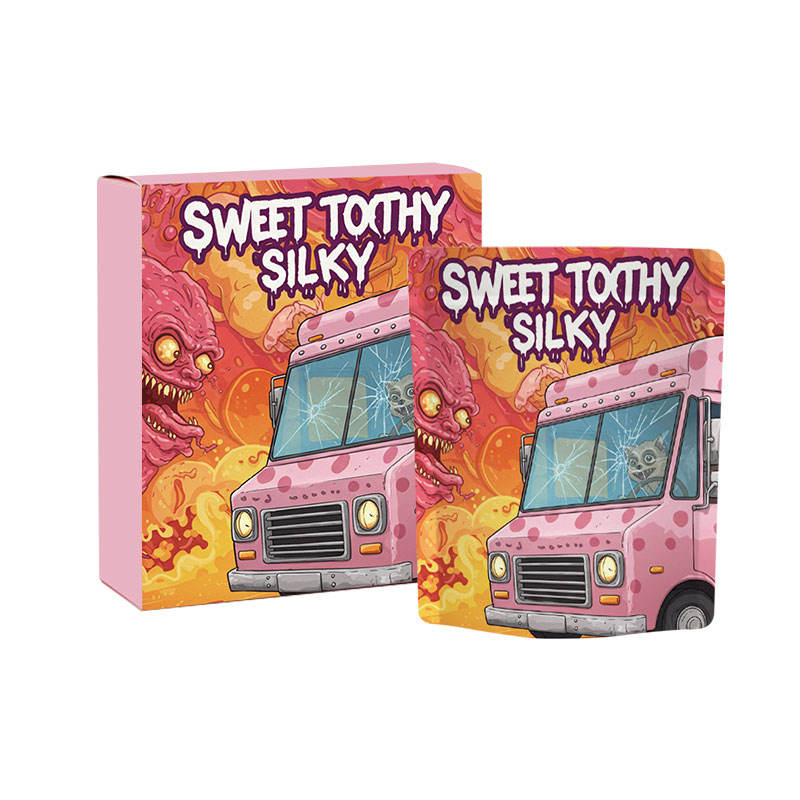
This 3.5g holographic Mylar box and bag set combines a custom printed flexible candy bag with a coordinated outer box. It is intended for candy brands, cannabis edible companies, private-label buyers, distributors, wholesalers, and multi-SKU programs seeking a unified holographic presentation. The 3.5g designation identifies the stated fill weight, but the correct bag and box dimensions must be selected around the actual candy pieces, required headspace, closure, and filling process.
Product Specifications
| Product type | Coordinated flexible bag and outer box packaging set |
|---|---|
| Stated fill weight | 3.5g |
| Intended contents | Candy; suitability for a specific candy formulation must be confirmed |
| Bag material | Holographic Mylar; the complete laminate structure requires buyer confirmation |
| Appearance | Holographic |
| Printing | Custom printed |
| Bag dimensions | To be confirmed from candy size, count, density, headspace, and filling method |
| Box dimensions and construction | To be coordinated with the finished filled bag and confirmed during specification |
| Pouch style and gusset | To be confirmed |
| Closure | To be confirmed; zipper, heat-seal, and child-resistant requirements are separate decisions |
| Barrier performance | Depends on the complete laminate, seal design, and production sealing conditions |
| Buyer applications | Custom, private-label, OEM/ODM, wholesale, and multi-SKU packaging programs |
How the Box and Bag Work Together
The inner bag provides the primary flexible package for the candy, while the outer box creates another printable surface and can add stiffness around the packed product. This two-component format gives brands room for product identity, flavor differentiation, ingredient information, warnings, directions, and market-specific labeling, subject to the applicable destination-market rules.
The bag and box cannot be sized independently. The filled bag must fit inside the box without excessive compression, folding, or movement. Seal widths, zipper placement, trapped air, candy shape, and the thickness of the finished bag all affect the required internal box space. A physical filled-pack trial or approved prototype is useful before final production specifications are locked.
Holographic Mylar Structure and Barrier Decisions
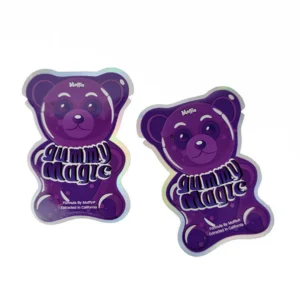
A holographic appearance describes the visual effect; it does not, by itself, establish oxygen, moisture, aroma, grease, or light-barrier performance. A holographic Mylar candy bag and box can be configured with a laminate selected for the candy formulation, expected shelf conditions, sealing method, and distribution environment. Final layer composition and food-contact requirements should be documented in the quotation and specification process.
Barrier packaging may help limit moisture or oxygen transfer and help contain aroma when the selected laminate and seals are appropriate. Puncture resistance matters when candy has sharp edges or when packages are packed tightly for distribution. Heat-seal compatibility matters because the sealant layer, sealing temperature, dwell time, pressure, and contamination in the seal area influence package integrity.
There is also a product-specific trade-off: the holographic surface offers strong visual movement, but intense reflections can reduce the readability of small text, fine lines, barcodes, or variable data. Strategic opaque panels, sufficient contrast, and a production proof may improve legibility. The outer box provides additional branding and stiffness, but it also introduces another dieline, artwork file, packing step, and dimensional tolerance that buyers must coordinate.
Confirming the Correct 3.5g Pack Size
A 3.5g candy packaging set does not have one universal size. Two candies with the same weight may occupy very different volumes because of piece count, shape, aeration, coating, and density. Buyers should provide the actual candy dimensions, target count, total fill weight, and desired headspace rather than selecting the package from weight alone.
- Too little headspace: the candy may interfere with the zipper or heat-seal area.
- Too much headspace: the bag may look underfilled and may not sit neatly inside the box.
- Insufficient box clearance: the filled bag may buckle, press against panels, or make box closure difficult.
- Excessive box clearance: the bag can shift during handling and weaken shelf presentation.
If a gusseted or stand-up configuration is requested, gusset depth and the filled footprint must be evaluated together. For a flat pouch, usable volume depends on the seal geometry and opening position. Pouch style remains a specification decision rather than a confirmed feature of this product input.
Custom Printing and Multi-SKU Artwork
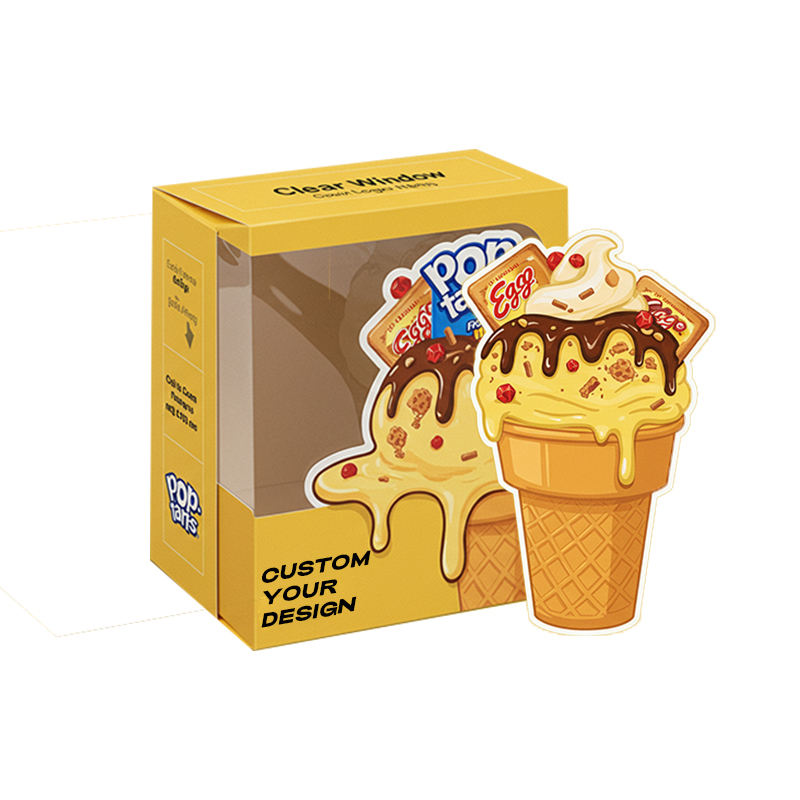
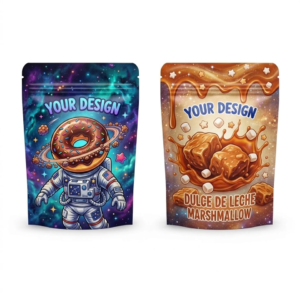
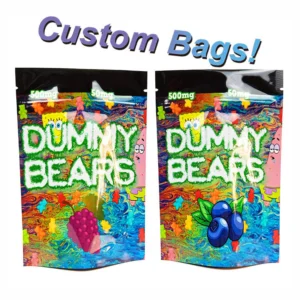
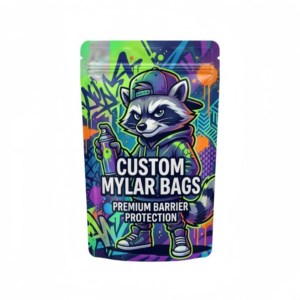
This custom printed holographic candy packaging format can support coordinated bag and box graphics, subject to the selected substrate, print process, dielines, and artwork review. Holographic areas, opaque white layers, fine text, color targets, registration, and finish transitions should be defined before approval. The printable area may be reduced by seals, folds, gussets, zipper zones, box flaps, and required quiet zones around codes.
For a private label edible packaging set, buyers should identify how many flavors, varieties, or market versions are required. A controlled design system can keep logos, warnings, net-content placement, and brand colors consistent while changing flavor names or product graphics. Each bag and its matching box should use clear version control to prevent mismatched components during packing.
Closures, Candy Protection, and Compliance Inputs
The product name does not confirm a zipper, tear notch, tamper-evident feature, or child-resistant mechanism. An ordinary resealable zipper helps consumers reclose a package but must not be represented as child-resistant unless the specified complete package and closure meet the required testing and documentation for the destination market. Heat sealing above a zipper may provide an initial sealed condition when the chosen structure and packing equipment are compatible.
Candy and cannabis edible packaging may require space for ingredients, allergen statements, serving information, net contents, warnings, symbols, batch or date coding, and other jurisdiction-specific information. Requirements vary by product and market. Buyers should identify food-contact documentation, child-resistant needs, opacity rules, tamper-evidence expectations, and labeling obligations during the RFQ rather than assuming that a holographic finish establishes compliance.
Frequently Asked Questions
Does 3.5g determine the bag and box dimensions?
No. A 3.5g fill weight does not determine volume because candy density, piece shape, count, coating, and headspace vary. Dimensions should be confirmed using the actual product and filling method.
Is holographic Mylar automatically a high-barrier material?
No. Holographic appearance does not establish barrier performance. Moisture, oxygen, aroma, light, and grease protection depend on the complete laminate structure and sealing system.
Does this packaging set include a resealable or child-resistant closure?
The closure is not confirmed by the product input. A zipper, heat seal, tear notch, or child-resistant system must be specified, and an ordinary zipper is not automatically child-resistant.
Can the bag and box use different artwork for each flavor?
Multi-SKU artwork can be quoted subject to the number of versions, print process, dielines, color requirements, and order allocation. Version control should keep each bag matched with its corresponding box.
What information is needed for an accurate packaging quotation?
Provide the candy type, 3.5g target fill, piece dimensions and count, desired bag and box dimensions, quantity, artwork versions, barrier needs, closure, finish, filling method, destination market, and applicable compliance requirements.
Request a Product-Specific B2B Quote
To request pricing from a wholesale cannabis candy packaging supplier, submit the candy type, actual piece size and count, 3.5g fill target, preferred pouch and box dimensions, order quantity, number of artwork versions, desired holographic coverage, laminate or barrier requirements, closure type, filling and sealing method, destination market, and compliance needs. These inputs allow the bag, outer box, artwork, and packing tolerances to be evaluated as one coordinated packaging system.
Reviews
There are no reviews yet.