
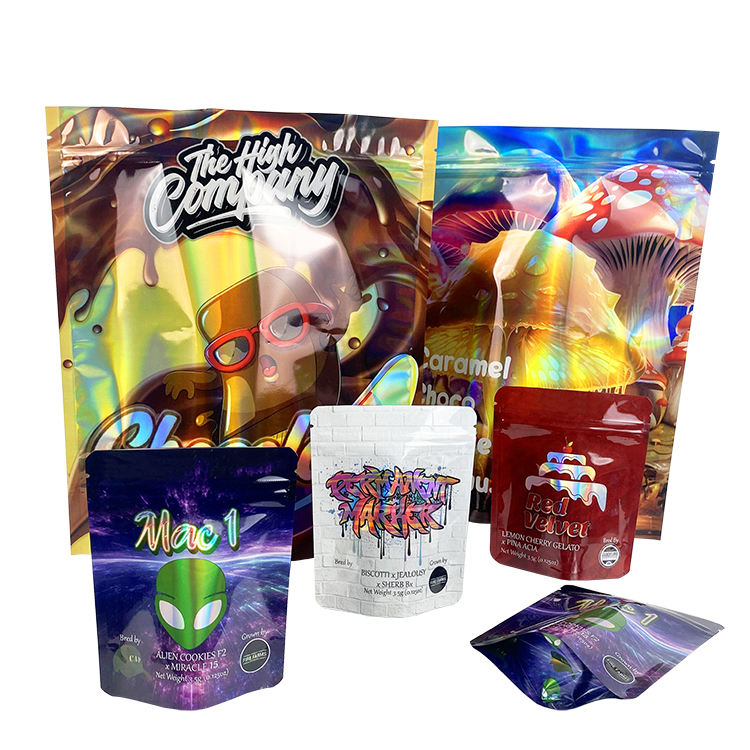
Custom Printed Holographic Mylar Bags for Cannabis Products
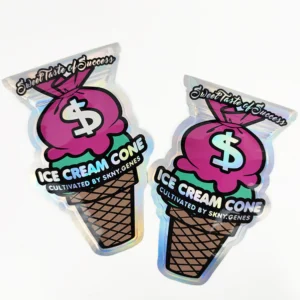
Custom printed holographic mylar bags are resealable zipper pouches for cannabis brands, distributors, wholesalers, and private-label buyers that need branded packaging with a reflective holographic appearance. The stated product combines custom printing, a holographic Mylar bag format, a resealable zipper, and a smell-resistant packaging objective. It may be specified for cannabis flower, pre-rolls, selected edibles, or other dry products after the contents, dimensions, material structure, closure, and destination-market requirements are confirmed.
Product Specifications
| Product type | Custom printed holographic resealable zipper Mylar bag |
|---|---|
| Primary material description | Mylar-based bag; confirm the complete laminate structure and barrier layers before production |
| Appearance | Holographic finish or holographic visual effect, subject to the selected substrate and artwork |
| Closure | Resealable zipper; an ordinary zipper should not be treated as a tested child-resistant closure |
| Printing | Custom printing; confirm artwork, print method, color requirements, and printable area |
| Odor function | Designed for smell-resistant packaging; aroma containment depends on the complete laminate and proper sealing |
| Size and capacity | Not supplied; confirm external dimensions, usable volume, fill weight, product density, and headspace |
| Intended B2B use | Cannabis product packaging, private-label programs, wholesale supply, and multi-SKU packaging |
Barrier Structure and Aroma Containment
The holographic appearance does not, by itself, identify the bag’s barrier performance. Buyers should request the proposed laminate or substrate structure and review how it supports the intended contents. A suitable structure may help reduce the movement of aroma, moisture, oxygen, or light, but each function depends on the complete material combination, seal geometry, and production specification.
For cannabis flower, aroma containment is especially relevant because volatile compounds can move through weak materials, incomplete seals, or an open zipper. These smell-resistant Mylar cannabis packaging bags can help contain aroma when the bag is properly closed, but “smell proof” should not be treated as an absolute or permanent guarantee without product-specific testing. Confirm whether the selected structure is intended for flower, pre-rolls, or another product format.
Barrier choices can create trade-offs. A higher-barrier opaque structure may provide stronger protection against light and help preserve sensitive contents, while a highly reflective holographic appearance may place limits on color reproduction, transparent areas, or artwork treatment. Mylar-based structures can also be engineered for different stiffness and heat-sealing behavior, so the final specification should balance protection, filling efficiency, shelf presentation, and sealing equipment.
Size, Fill Weight, and Headspace Planning
Do not select a pouch solely from a nominal cannabis fill weight. Flower density, trim size, product compression, and desired headspace affect the usable volume. The same stated weight may require different dimensions for dense and airy flower. Excessive compression can affect presentation and may stress the zipper or heat-seal area, while too much empty space can increase movement during handling.
For pre-rolls, confirm the number of units, individual length, diameter, orientation, and crush-risk concerns. For edibles, identify whether the product is dry, oily, sticky, or moisture-sensitive. Grease resistance, moisture barrier needs, food-contact requirements, warning space, and resealability should be reviewed for the actual formulation rather than assumed from the holographic finish.
Pouch Use, Zipper, and Sealing Decisions
The resealable zipper supports repeated opening and closing, but it does not replace a properly specified heat seal where tamper evidence, initial closure, or added aroma containment is required. Ask the supplier to clarify whether the design includes a top heat seal, tear notch, or another opening feature. A tear notch can improve consumer access, but its position must not interfere with the zipper, artwork, or required label information.
An ordinary resealable zipper should be kept distinct from a tested child-resistant closure. If the destination market requires child-resistant packaging, state that requirement at the RFQ stage and request the appropriate closure design and supporting documentation. Do not assume that a zipper bag is child-resistant because it is difficult for some users to open.
Custom Printing and Holographic Artwork
Custom printing lets a cannabis brand coordinate packaging across strains, product types, and private-label programs. Before approving artwork for custom printed weed baggies for private label, confirm the usable print area, seal zones, zipper position, tear-notch location, holographic treatment, color expectations, and any registration requirements. A holographic surface can change how metallic effects, fine text, gradients, and dark colors appear, so a digital proof or physical sample may be useful before a production decision.
Keep mandatory information and variable SKU data organized from the start. Brand identity, strain or product name, net contents, batch information, warnings, symbols, and destination-market information may require separate placement or later application. The packaging supplier can confirm what is printable on the bag, but the buyer remains responsible for validating the final copy and market-specific requirements.
Multi-SKU and Wholesale Procurement
For a multi-SKU program, define which elements remain consistent and which change by SKU. Consistent dimensions, zipper placement, laminate, holographic treatment, and print registration can simplify filling and merchandising. Variable strain names, flavors, colors, or compliance panels should be supplied in a controlled artwork schedule to reduce version errors.
Buyers sourcing from a cannabis Mylar bag manufacturer wholesale program should request a specification sheet, artwork template, sample approval process, and clear identification of each printed version. Confirm whether different SKUs use the same material and closure specification. If not, compare them separately because a visual match does not prove identical barrier, seal, or mechanical performance.
Destination-Market and RFQ Checks
Packaging rules differ by destination and by cannabis product category. Confirm the required warning language, labeling area, tamper-evidence expectations, child-resistance requirements, recycling or material disclosures, and any product-contact or testing documentation needed for the market. The bag’s holographic appearance and resealable zipper do not establish compliance on their own.
For an accurate quotation, provide the actual contents, target fill weight, product dimensions or density, desired pouch dimensions, quantity, number of artwork versions, laminate or barrier preference, zipper requirements, holographic finish, filling method, destination market, and compliance needs. These details allow the supplier to evaluate capacity, headspace, seal placement, artwork feasibility, and the most appropriate structure.
Frequently Asked Questions
Are these holographic Mylar bags completely smell proof?
They are specified for a smell-resistant packaging objective and may help contain aroma when properly sealed. Actual performance depends on the complete laminate, zipper, heat seal, and closure condition, so request product-specific confirmation rather than relying on an absolute smell-proof claim.
Can the bags be used for cannabis flower?
They can be evaluated for cannabis flower, but the correct size depends on flower density, target fill weight, headspace, and the desired presentation. Confirm the contents and filling process before selecting dimensions.
Is the resealable zipper child resistant?
Not necessarily. A standard resealable zipper is different from a tested child-resistant closure. If child-resistant packaging is required, identify it in the RFQ and request the applicable design and documentation.
Does the holographic finish define the barrier performance?
No. Holographic appearance describes the visual treatment, not the complete barrier structure. Confirm the laminate, opacity, seal construction, and intended protection against aroma, moisture, oxygen, and light.
What information should a private-label buyer send for a quote?
Send the product type, actual fill weight or dimensions, desired pouch dimensions, quantity, artwork versions, material or barrier preference, zipper and seal requirements, finish, filling method, destination market, and compliance needs.
Request a B2B Packaging Specification and Quote
To evaluate these custom printed holographic mylar bags for your cannabis program, send the contents, fill weight or actual product dimensions, desired pouch dimensions, order quantity, artwork versions, material or barrier preference, closure and heat-seal requirements, holographic finish, filling method, destination market, and compliance needs. The supplier can then confirm the suitable structure, usable volume, artwork area, and quotation basis for your project.
Reviews
There are no reviews yet.